1987
Directed by David Irving
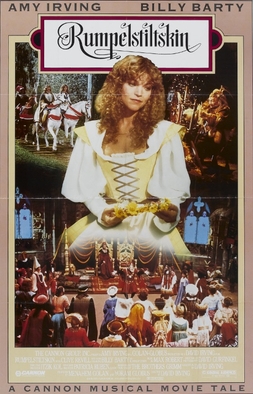
Welcome back to Movie Monday, where I continue my journey through the cinematic wasteland of films that have earned permanent residence in my personal hall of shame. As always, the disclaimer: this list is purely subjective, shaped by my own experiences and tastes. If Rumpelstiltskin holds a special place in your heart—if the musical numbers charmed you, if Billy Barty’s performance resonated with you, if you found the Cannon Movie Tales series to be a delightful addition to fairy tale adaptations—I’m not here to diminish that. I’m just here to explain why, for me, this 1987 musical fantasy represents everything that can go wrong when you try to stretch a simple fairy tale into feature-length mediocrity.
This week brings us to number 32: Rumpelstiltskin, a film that looked at an already odd Brothers Grimm fairy tale and somehow made it both longer and less interesting. It’s a movie that proved even at 84 minutes, you can still be too long. It’s part of the Cannon Movie Tales series—an ambitious $50 million project to adapt sixteen fairy tales that, based on this installment, was perhaps not the wisest investment Cannon Films ever made.
The Sleepover Rental That Bombed
Picture this: sometime around 1987 or early 1988, I’m about seven or eight years old, and my cousin is over for a sleepover. My parents, bless their hearts, went to the video store and rented what they assumed would be a perfectly entertaining movie for kids. It’s a fairy tale adaptation! It’s got music! It stars Amy Irving, who was in movies like The Fury and Carrie! What could possibly go wrong?
Everything. Everything could go wrong.
I don’t remember every detail of that viewing experience—I was young, and the movie was forgettable enough that most of it has mercifully faded from memory. But what I do remember is that my cousin and I spent most of the runtime mocking it. At seven or eight years old, we weren’t sophisticated film critics. We didn’t have nuanced takes on pacing issues or production design. We just knew when something was boring, when something was trying too hard, when something was supposed to be entertaining but absolutely wasn’t.
We made fun of the songs. We made fun of the costumes. We probably made fun of things that didn’t deserve mockery because we were bored children looking for any source of entertainment, and if the movie wasn’t going to provide it, we’d create our own by roasting what was on screen.
But the thing that really stuck with me—the moment that has survived in my memory for nearly forty years—is the little girl at the end of the film saying “Rumpelstiltskin.” I don’t even remember the context anymore. I just remember that delivery, that reading of the name, and my cousin and I absolutely losing it. We repeated it over and over, doing our best impressions, cracking ourselves up with the kind of humor that only makes sense to children who are simultaneously exhausted from staying up late and punchy from watching a bad movie.
That’s what Rumpelstiltskin gave me: not entertainment, not wonder, not the magic of fairy tales brought to life. Just a single line reading that became an inside joke between two kids who desperately wished they were watching literally anything else.
The Cannon Movie Tales Experiment
To understand Rumpelstiltskin, you need to understand the bizarre ambition of Menahem Golan and Yoram Globus, the legendary schlockmeisters behind Cannon Films.
Cannon was a studio that operated on quantity over quality, churning out low-budget action films, exploitation movies, and whatever else they thought might turn a profit. They gave us the Charles Bronson Death Wish sequels, Chuck Norris vehicles, and Masters of the Universe—a mixed bag of guilty pleasures, legitimate trash, and occasional surprises. They were the cinematic equivalent of throwing everything at the wall and seeing what stuck.
In the mid-1980s, Golan and Globus decided to get into the family entertainment business with the Cannon Movie Tales series. The plan was ambitious: adapt sixteen classic fairy tales into live-action musical films with a combined budget of $50 million. They would film them quickly and cheaply (mostly in Israel to save money), package them for theatrical and home video release, and presumably make a fortune off families looking for wholesome entertainment.
Rumpelstiltskin was the first of these films to be released in the United States, premiering in April 1987 after being the opening night attraction at Cannon’s “family film festival” at the Cannes Film Festival. If this was meant to be the flagship that launched the entire series, the best foot forward to demonstrate what the Cannon Movie Tales could accomplish, then I shudder to think what the other fifteen films must have been like.
Actually, that’s not entirely fair—I haven’t seen the other films in the series, so maybe they’re masterpieces. Maybe Rumpelstiltskin is the worst of the bunch and everything else is delightful. But based on this installment, I’m not exactly rushing to track down the rest of the collection.
The Irving Family Reunion
One of the more interesting aspects of Rumpelstiltskin is that it’s essentially a family affair. Amy Irving stars as Katie, the miller’s daughter. Her brother, David Irving (not the controversial British author of the same name, thankfully), wrote the screenplay and directed. Their mother, actress Priscilla Pointer, appears as the Queen.
This creates an odd dynamic where you’re watching what amounts to a home movie with a slightly bigger budget. I’m not suggesting nepotism is inherently bad—plenty of great films have been made by family members working together. But when the end result is this uninspired, you can’t help but wonder if the Irving family might have been better served having a nice dinner together instead of making a movie.
Amy Irving does her best with the material. She has a genuinely good singing voice, and you can tell she’s trying to bring some life to Katie. But there’s only so much any actress can do when the songs themselves are forgettable and the script gives her nothing interesting to work with. She deserved better material, better direction, and probably a better career decision than agreeing to star in this.
As for David Irving’s direction… well, let’s just say that the choices made throughout this film are questionable at best. The pacing drags despite the short runtime. The musical numbers feel awkwardly staged. The performances range from “trying too hard” to “not trying at all,” which suggests that either the actors weren’t being given clear direction or they were being given very bad direction and following it faithfully.
Billy Barty and the Title Role Curse
Billy Barty was a talented actor with a long career spanning decades. I enjoyed him in Willow, where he played the High Aldwin with real charm and presence. I even liked him in Masters of the Universe, itself a deeply problematic film that somehow manages not to crack my worst movies list despite its many, many flaws (it’s probably a nostalgia thing). Barty brought energy and personality to his roles, making the most of parts that could have easily been thankless or stereotypical.
Rumpelstiltskin gave Billy Barty his only lead role. This should have been a triumph—a chance for a character actor who’d spent his career in supporting parts to finally carry a film. Instead, it’s a testament to how even a talented performer can’t overcome fundamentally broken material.
The problem isn’t Barty’s performance, exactly. He’s doing what he can with the role. The problem is that the character of Rumpelstiltskin, as written and directed here, isn’t particularly interesting or entertaining. The fairy tale itself presents challenges—Rumpelstiltskin is kind of a weird character to center a film around, a supernatural creature who helps the heroine under increasingly bizarre conditions and then throws a tantrum when she guesses his name.
The film doesn’t solve these challenges. If anything, it exacerbates them by stretching the already thin story to feature length without adding depth, complexity, or meaningful character development. We’re left watching Billy Barty do his best with a script that doesn’t understand what makes the character work or why audiences should care about him.
It’s not fair to criticize Barty for taking the role—it was a lead part in a theatrical film, which doesn’t come around often for any actor, let alone one who was consistently typecast based on his height. But watching the finished product, you can’t help but wish his first and only lead role had been in something better, something that would have showcased his talents rather than squandering them.
The Musical Numbers That Weren’t
Let’s talk about the elephant in the room: Rumpelstiltskin is a musical, and the musical numbers are not good.
Now, I’m not a musical theater expert. I can’t break down the technical aspects of composition or choreography with any authority. But I know when songs work and when they don’t, and these don’t. They’re not catchy. They’re not memorable. They’re not even particularly enjoyable in the moment. They’re just… there, taking up runtime, filling space between plot points.
Amy Irving genuinely can sing—her voice is pleasant and she hits the notes. But a good voice can’t save a mediocre song. If the melody isn’t engaging, if the lyrics aren’t clever or emotionally resonant, if the staging doesn’t add visual interest, then it doesn’t matter how technically proficient the performance is. You’re still going to be bored.
The real sin of the musical numbers in Rumpelstiltskin is that they’re forgettable. I’ve seen this movie twice in my life—once as a child and once recently while attempting to prepare for this blog post—and I cannot hum a single song from it. I cannot remember a single lyric. The music passed through my consciousness without leaving any impression whatsoever, which is perhaps the worst thing you can say about a musical.
A bad song from a musical at least sticks with you, becomes a punchline, lives on as a meme or a joke. A forgettable song just disappears, wasted effort that accomplished nothing. Rumpelstiltskin‘s musical numbers are aggressively forgettable, and in some ways, that’s worse than being actively terrible.
The Pacing Problem
Here’s something that will blow your mind: Rumpelstiltskin has a runtime of 84 minutes. That’s it. Barely over an hour and twenty minutes. Many films would kill for that kind of efficiency. Most modern blockbusters are at least two hours, often pushing two and a half or three.
And yet, somehow, Rumpelstiltskin feels interminable.
Richard Harrington of The Washington Post nailed it in his review: “All Cannon has done… is to make a short story long. And long and longer.” The Rumpelstiltskin fairy tale is maybe three pages in a Brothers Grimm collection. It’s a simple story: miller’s daughter must spin straw into gold, mysterious man helps her in exchange for increasingly steep prices, she becomes queen, he demands her firstborn child, she escapes the bargain by guessing his name. That’s it. That’s the whole story.
Stretching that to 84 minutes requires padding. Lots of padding. Musical numbers that don’t advance the plot. Scenes that repeat the same information. Characters who exist solely to eat up screen time. The film doesn’t deepen the story or add meaningful complexity—it just makes everything take longer.
When I was a kid watching this with my cousin, we were bored. When I tried to rewatch it recently to prepare for this blog post, I couldn’t even make it through. I gave up partway through, which almost never happens. I have sat through some truly terrible movies for this blog series. I have endured films that actively insulted my intelligence and wasted my time. But something about Rumpelstiltskin‘s particular brand of tedium broke me.
It’s easier to believe that Peter Jackson pulled three movies out of The Hobbit than that David Irving managed to pull one feature-length film out of this fairy tale. At least Jackson’s padding included elaborate action sequences and stunning visuals. Rumpelstiltskin‘s padding is just… more Rumpelstiltskin.
The Cheapness of It All
Calling Rumpelstiltskin cheaply made is an understatement. This movie looks and feels like it was assembled from whatever was lying around the Cannon Films prop department and shot on whatever sets happened to be available.
The costumes look like they came from a community theater production’s storage closet. The sets are sparse and unconvincing. The cinematography is flat and uninteresting. Everything about the production design screams “we had no money and even less time.”
Now, low budgets don’t automatically make bad movies. Plenty of classics were made for pennies. The original Halloween cost $300,000 and changed horror cinema forever. Roger Corman built an entire career on making entertaining films with minimal resources.
The difference is that those filmmakers knew how to work within their limitations. They understood what they could accomplish with the resources available and crafted their films accordingly. They were creative, inventive, and resourceful.
Rumpelstiltskin just looks cheap. There’s no creativity in how it uses its limited budget, no clever workarounds or inspired solutions. It’s just a cheaply made movie that looks exactly as cheap as it was, and that cheapness undermines any chance the film had at creating the magic and wonder that fairy tales are supposed to evoke.
When you’re adapting a story about spinning straw into gold, about magic and mystery and transformation, the last thing you want is for your audience to be thinking about how fake everything looks. But that’s exactly what Rumpelstiltskin invites you to do at every turn.
The Odd Fairy Tale That Got Odder
I’ll admit something: I’ve always thought Rumpelstiltskin was kind of a weird fairy tale, even by Brothers Grimm standards.
Think about it. A miller lies about his daughter being able to spin straw into gold. A king, rather than questioning this obvious impossibility, decides to test it by locking the daughter in a room with straw and threatening to kill her if she fails. A magical creature appears and offers to do the impossible task in exchange for increasingly bizarre payment—first a necklace, then a ring, then her firstborn child. She becomes queen, has a baby, and the creature returns to collect. She gets out of the deal by guessing his name, which he apparently told to no one but happened to shout while dancing around a fire in the woods where someone overheard him.
It’s bonkers. The motivations don’t make sense. The logic is dream-like at best, nonsensical at worst. The resolution depends on coincidence and the title character’s inexplicable carelessness.
But fairy tales don’t have to make logical sense. They’re symbolic, archetypal, speaking to something deeper than surface-level narrative coherence. The best fairy tale adaptations understand this and either embrace the dreamlike quality or find ways to make the story resonate on an emotional level that transcends logic.
Rumpelstiltskin does neither. It just presents the story more or less as written, padding it out with forgettable songs and mediocre performances, without adding anything that would make us care about what’s happening or understand why this story has survived for centuries.
The end result is a film that takes an already odd fairy tale and somehow makes it less interesting. That’s quite an achievement, in its own terrible way.
The Recent Viewing I Couldn’t Finish
For the purposes of writing this blog post, I knew I should probably rewatch Rumpelstiltskin. It had been nearly forty years since that childhood viewing, and I wanted to approach it with adult eyes, to see if there was anything I’d missed or misremembered, to give it a fair shake before consigning it to my worst movies list.
The good news for any readers who want to subject themselves to this experience: the film is available on Amazon Prime Video. You don’t even have to hunt down a dusty VHS tape or track down the 2005 MGM DVD release. It’s right there, ready at the push of a button, waiting to disappoint a whole new generation of viewers.
I started watching. I gave it my full attention. I tried to approach it with an open mind, setting aside my childhood memories and the negative reviews I’d read over the years.
I couldn’t finish it.
That almost never happens. As I mentioned earlier, I have sat through some truly abysmal films for this blog series. I have endured nonsensical plots, terrible acting, offensive content, and mind-numbing boredom. I pride myself on my ability to power through even the worst cinematic experiences so I can give them a fair assessment.
But something about Rumpelstiltskin defeated me. Maybe it was the combination of boredom and bad memories. Maybe it was the realization that nothing had improved with age, that the film was exactly as tedious and uninspired as I remembered. Maybe I just didn’t have it in me to waste another 84 minutes on a movie I already knew I hated.
I tapped out. I gave up. And I don’t feel bad about it. Life is too short to finish bad movies you’re not getting paid to watch, especially when you already know how the story ends because it’s a famous fairy tale and there are no surprises to be found.
So my rewatch is incomplete, my adult perspective is limited, and my assessment of the film is still heavily influenced by the childhood viewing that left such a negative impression. If that makes my criticism less valid, so be it. But I suspect finishing the film wouldn’t have changed my opinion anyway.
The Love I Have for Better Fairy Tale Adaptations
To be fair to the fairy tale adaptation genre, I should acknowledge that not all such films are terrible. The classic Disney animated versions are usually enjoyable, even when they’re obviously Disney-fied to be more family-friendly than the original tales. Snow White, Cinderella, Sleeping Beauty—these films took dark, often disturbing fairy tales and transformed them into something magical and timeless.
I even consider The Wizard of Oz to be a quintessential American fairy tale, and it’s one of the greatest films ever made. It understood how to balance the fantastical with the emotional, how to create a world that felt both impossible and real, how to use the fairy tale structure to tell a story about growing up and finding courage and appreciating home.
These films work because they understand what makes fairy tales resonate. They don’t just recreate the plot points—they capture the feeling, the wonder, the sense that we’re being told a story that matters.
Rumpelstiltskin doesn’t do any of that. It mechanically reproduces the fairy tale without understanding why anyone cared about it in the first place. It’s the difference between a genuine folk song passed down through generations and a cover version performed by people who don’t understand the original melody or meaning.
Why Rumpelstiltskin Earns Its Spot at Number 32
Rumpelstiltskin lands at number 32 on my worst movies list because it represents the unique torture of boring, uninspired mediocrity.
It’s not offensively bad like some films on this list. It’s not a betrayal of beloved source material like last week’s Halloween: The Curse of Michael Myers. It doesn’t make catastrophic creative decisions that ruin everything. It’s just… dull. Tedious. Forgettable.
And in some ways, that’s worse. At least spectacularly bad films give you something to talk about, something to react to, some entertainment value in their awfulness. Rumpelstiltskin can’t even manage that. It’s just there, taking up space, wasting the talents of everyone involved, teaching children that fairy tales can be boring and that musicals don’t have to be fun.
The film wastes Billy Barty’s only lead role. It squanders Amy Irving’s talents. It proves that ambitious projects—like Cannon’s plan to adapt sixteen fairy tales—sometimes fail right out of the gate. Most of all, it takes 84 minutes to tell a story that should take 10, and those 84 minutes feel like an eternity.
Leonard Maltin gave it two stars out of four and said it would “bore even the small fry.” As a member of the small fry in 1987, I can confirm: it did. And nearly forty years later, it still does.
The Bottom Line
Rumpelstiltskin is what happens when you take a simple fairy tale, strip out anything interesting or magical about it, add some forgettable songs, cast it with people who are trying their best with terrible material, and stretch it to a feature length it was never meant to sustain.
It’s a film that taught me, even as a child, that not all fairy tale adaptations are created equal. That sometimes the most wholesome-looking family entertainment can be the most boring. That 84 minutes can feel like three hours if the movie is tedious enough.
If you’re morbidly curious, it’s on Amazon Prime, ready to disappoint you. But I’d recommend literally any other fairy tale adaptation instead. Watch the Disney classics. Watch The Princess Bride. Watch Shrek, which successfully deconstructs fairy tales with more wit and charm than Rumpelstiltskin brings to presenting one straight.
Or, you know, just read the original Brothers Grimm tale. It’ll take you five minutes, and at the end, you’ll have experienced everything this movie has to offer and saved yourself 79 minutes of your life.
Some fairy tales deserve to be adapted into films. This one might not have been one of them. And even if it was, this particular adaptation proves that just because you can make something doesn’t mean you should.
Next Week on Movie Monday
Join me next Monday when we continue down the list with a franchise I was introduced to in high school that failed to impress. Wait… can you call it a franchise if there were only two movies? Anyway… until then, may your fairy tale adaptations have memorable songs, may your productions have adequate budgets, and may you never have to guess someone’s name to save your firstborn child from a magical creature.
What are your thoughts on Rumpelstiltskin or the Cannon Movie Tales series in general? Did you see any of these films as a kid? Do you have a favorite fairy tale adaptation, or one that disappointed you as much as this one disappointed me? Share your experiences in the comments below—I’m particularly curious to hear from anyone who actually enjoyed this film and can explain what I missed.
 The Confusing Middle