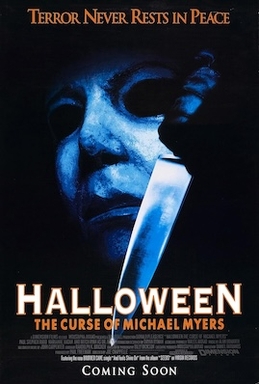
Halloween: The Curse of Michael Myers
1995
Directed by Joe Chappelle
Welcome back to Movie Monday, where I continue my masochistic journey through the films that have left permanent scars on my cinematic psyche. As always, the usual caveat applies: this list is entirely subjective, shaped by my personal experiences and prejudices. If Halloween: The Curse of Michael Myers holds a special place in your heart—if the Thorn subplot resonated with you, if you found Donald Pleasence’s final performance moving, if you think explaining Michael Myers’ origins added depth to the character—I’m not here to take that away from you. I’m just here to explain why, for me, this movie represents one of the most spectacular misfires in a franchise that I genuinely love.
This week brings us to number 33: Halloween: The Curse of Michael Myers, a 1995 sequel that took everything mysterious and terrifying about Michael Myers and decided to explain it all with ancient Druid curses, evil cults, and a convoluted mythology that nobody asked for and nobody wanted.
Growing Up with the Shape
Before I can properly dissect this disaster, I need to establish my credentials as a Halloween fan. Thanks to a mother who loved the franchise, I was introduced to the series at a young age. While other kids were watching Disney movies and age-appropriate content, I was being educated in the fine art of slasher cinema. By the time Halloween: The Curse of Michael Myers hit theaters in 1995, I was fifteen years old and had already seen every film in the franchise.
I’d watched Laurie Strode survive two encounters with her murderous brother. I’d seen Michael Myers hunt down his niece Jamie Lloyd across two films. I’d even sat through Halloween III: Season of the Witch, the franchise’s bizarre detour into android-assisted child murder via cursed Halloween masks. I wasn’t a casual fan—I was invested in this series, warts and all.
So when Halloween 5: The Revenge of Michael Myers ended with that frustrating cliffhanger—the mysterious Man in Black breaking Michael out of the Haddonfield police station, leaving us with more questions than answers—I was genuinely anticipating the next installment. Who was the Man in Black? What was his connection to Michael? What did that mysterious rune symbol tattooed on Michael’s wrist mean? These were questions that demanded answers.
I just didn’t realize how much I would regret wanting those answers.
A Mother-Son Blockbuster Night (Maybe)
The memory is fuzzy on whether mom decided I was old enough to accompany her to see Halloween: The Curse of Michael Myers in theaters, or whether this became a Blockbuster Video rental at some point shortly after its theatrical run. I lean toward the latter—by 1995, our ritual of hitting the video store on Friday nights was well-established, and a new Halloween movie would have been an automatic rental.
Either way, what I remember clearly is my reaction: profound disappointment bordering on betrayal. Halloween 5 had already tested my patience with its nonsensical psychic connection between Jamie and Michael, its inexplicable Man in Black subplot, and its general incoherence. But at least it maintained some of the franchise’s core appeal—Michael Myers as an unstoppable, unknowable force of evil stalking Haddonfield.
Halloween: The Curse of Michael Myers looked at that foundation and said, “You know what this needs? Ancient Celtic curses, evil fertility cults, forced impregnation, and a scientific explanation for why Michael can’t be killed!” It was like watching someone take a simple, elegant design and cover it with unnecessary ornamentation until the original form was completely obscured.
Who knew I would wind up thinking this one was even worse than Halloween 5? At least that film’s problems stemmed from poor execution rather than fundamentally misunderstanding what made the franchise work in the first place.
The Thorn in the Franchise’s Side
Let’s address the elephant in the room: the Curse of Thorn subplot is an absolute mess.
For those fortunate enough to have never subjected themselves to this film, here’s the basic concept: Michael Myers isn’t just a masked killer. He’s under the influence of an ancient Druid curse called Thorn, which compels him to murder his entire bloodline every Halloween. This curse is apparently administered by a secret cult of Druids who have infiltrated Haddonfield (including kindly old Mrs. Blankenship, because why not?). The cult has also kidnapped Michael’s niece Jamie Lloyd, forcibly impregnated her, and used her baby as part of their evil schemes to understand and control pure evil.
If that sounds convoluted, confusing, and completely antithetical to everything that made Michael Myers scary in the first place, congratulations—you understand the problem.
The original Halloween worked because Michael Myers was the embodiment of pure, motiveless malignancy. He was, as Dr. Loomis described him, “purely and simply evil.” There was no explanation, no backstory that would make him comprehensible or sympathetic. He was the boogeyman, the shape in the shadows, the thing that goes bump in the night. His unknowability was the source of his terror.
The minute you start explaining why Michael does what he does—the minute you give him an origin story involving ancient curses and evil cults—you begin to humanize him. And that takes away what makes him scary. Instead of a force of nature, he becomes a victim of circumstance, a puppet controlled by forces beyond his understanding. The simplicity and purity of his evil is replaced by mythology and explanation.
I think it was stupid. No minced words there. In my opinion, Michael Myers is much more terrifying if we have no idea who he really is or why he does what he does. The Thorn subplot doesn’t add depth to the character—it diminishes him.
The Jamie Lloyd Problem
One of my biggest disappointments with Halloween: The Curse of Michael Myers is its treatment of Jamie Lloyd, a character who had been the emotional center of the previous two films.
Jamie, played by Danielle Harris in Halloween 4 and 5, was a genuinely compelling addition to the franchise. She was Michael’s niece, living with the trauma of having a serial killer for an uncle, haunted by nightmares and visions, struggling with the fear that she might have inherited his evil. The fourth film ended with her apparently succumbing to that fear, and the fifth film explored her psychological torment. She was a character with potential, a way to explore the legacy of trauma and violence across generations.
Halloween: The Curse of Michael Myers takes this character, ages her up to fifteen, reveals that she’s been held captive by the cult for six years, forces her to give birth to Michael’s child (a deeply disturbing implication I’ll address momentarily), and then kills her off in the first fifteen minutes of the film.
That’s it. That’s all the resolution Jamie Lloyd gets after being the protagonist of two films. A rushed, unceremonious death that happens so early in the runtime that it barely registers. The film doesn’t even give Danielle Harris the dignity of reprising the role—actress J.C. Brandy takes over, appearing in only a handful of scenes before Jamie is dispatched.
It’s a waste of a character and a waste of the emotional investment the previous films had built. Jamie deserved better than being reduced to a plot device whose only purpose is to birth a cursed baby and then die.
The Implication We Don’t Discuss
And while we’re on the subject of Jamie’s baby, let’s address the deeply uncomfortable implication the film makes: that Michael Myers is the father of his own niece’s child.
The film never explicitly states this—probably because even the filmmakers realized how profoundly disturbing that would be—but the implication is pretty clear. Jamie has been held captive by the cult for six years, Michael has been there too, and she’s given birth to a baby that the cult considers important to their plans for Michael. The math is uncomfortable at best, horrifying at worst.
This is the kind of gratuitous darkness that doesn’t add anything meaningful to the story. It’s not psychological depth; it’s just gross. The original Halloween had implicit sexual undertones—Michael’s murders on Halloween night, the targeting of sexually active teenagers—but those undertones worked as subtext, as symbolic commentary on adolescent anxieties and puritanical punishment.
Making Michael a sexual predator who impregnated his teenage niece isn’t subtext—it’s just needlessly repulsive, adding a layer of sexual violence to a character whose terror came from his complete lack of human motivation. It’s the kind of decision that makes you wonder what the filmmakers were thinking, or if they were thinking at all.
Paul Rudd: Innocent Bystander
I need to address the common criticism of Paul Rudd’s performance as adult Tommy Doyle, because I think it’s fundamentally unfair.
Yes, Rudd’s performance in Halloween: The Curse of Michael Myers is awkward, stilted, and lacking in charisma. Tommy is supposed to be a traumatized recluse obsessed with understanding Michael Myers, and Rudd plays him as exactly that—socially awkward, intense, and uncomfortable to watch. It’s not a good performance, but I’m not sure any performance could have salvaged the material he was given.
More importantly, this was essentially Paul Rudd’s first major film role. What else had he done by this point? A Super Nintendo commercial? Clueless hadn’t even been released yet. Anchorman and Ant-Man weren’t even a gleam in his eyes. He was a young actor trying to make it in Hollywood, taking whatever work he could get, doing his best with a poorly written character in a troubled production.
Criticizing Paul Rudd for his performance in Halloween: The Curse of Michael Myers is like criticizing a Little League player for not hitting major league pitching. He wasn’t ready for this, the material wasn’t good enough to elevate, and the troubled production meant nobody was doing their best work. Give the guy a break.
Besides, we all know how this story ends: Paul Rudd went on to become one of the most charming and talented comedic actors of his generation. This film is just an awkward footnote in his résumé, a reminder that everyone has to start somewhere, and sometimes “somewhere” is a troubled Halloween sequel with a nonsensical plot about Druid curses.
Donald Pleasence’s Tragic Farewell
The most bittersweet aspect of Halloween: The Curse of Michael Myers is that it marks Donald Pleasence’s final appearance as Dr. Sam Loomis, a role he’d inhabited since the original 1978 film.
This is a hard one to answer when people ask me how I feel about Pleasence’s final performance. As a fan of the films, it’s good to see him return one final time. Pleasence was the soul of the Halloween franchise, the one constant presence across multiple sequels, the voice of moral authority warning about the evil of Michael Myers. His performance in the original film—his monologue about looking into Michael’s eyes and seeing “the devil’s eyes”—is one of the most chilling moments in horror cinema.
But this is a bad movie, and even his part is poorly written and executed. So it’s a little of both. It’s a tragic farewell and it’s painful to watch.
Pleasence was reportedly in ill health during the production, which is evident in some scenes where he looks frail and exhausted. He died on February 2, 1995, seven months before the film was released, meaning he never saw the finished product. The film is dedicated to his memory, which is touching, but it’s also a reminder that this deeply flawed film is now forever associated with the end of his life.
I want to believe that Pleasence, professional that he was, gave his all to this role even when the material didn’t deserve it. I want to believe he found some satisfaction in playing Dr. Loomis one final time, regardless of the quality of the film around him. But watching the finished product, knowing he’s gone, knowing this is how his association with the franchise ended, is genuinely painful.
Dr. Loomis deserved a better sendoff. Donald Pleasence deserved a better final film. The fact that we got this instead is one of the great tragedies of the Halloween franchise.
The Producer’s Cut Debate
After the film’s theatrical release, horror fans discovered that an earlier cut of the film—known as the Producer’s Cut—existed and had been shown at test screenings. This version featured approximately 45 minutes of different footage, including a substantially different ending. Bootleg copies circulated for years before Scream Factory officially released it in 2014.
Over the years, I’ve seen both cuts. The debate among Halloween fans about which version is superior has raged for decades, with many arguing that the Producer’s Cut is the superior film.
I’m here to tell you: they’re both bad.
Yes, the Producer’s Cut is incrementally better. It’s slightly more coherent, gives Dr. Loomis more to do, and features a less nonsensical ending than the theatrical cut’s bizarre laboratory climax. But “less nonsensical” doesn’t mean “good”—it just means “slightly less terrible.”
The Producer’s Cut ultimately just pads the runtime with additional ridiculous plot points that were kept out of the theatrical cut. The core problems with the film—the convoluted Thorn mythology, the mishandling of Jamie Lloyd, the fundamental misunderstanding of what makes Michael Myers scary—exist in both versions. You can rearrange the deck chairs on the Titanic all you want; it’s still sinking.
The existence of two versions of the film does highlight just how troubled the production was. When you have two substantially different cuts of a film, neither of which works, it’s evidence that something went fundamentally wrong during development. No amount of editing or reshooting could fix the script’s core problems.
The Troubled Production Nobody Knew About
When I first saw Halloween: The Curse of Michael Myers at age fifteen, I had no idea about the troubled production behind it. This was 1995—the internet wasn’t what it is now. Behind-the-scenes movie rumors weren’t available by tapping the touchscreen of a tiny computer in my pocket. If you wanted to know what happened during a film’s production, you had to wait for magazine articles or special features on home video releases.
It wasn’t until years later that I learned about the full extent of the production nightmare: the multiple screenwriters, the endless script revisions, the directors who came and went, the test screening disaster, the rushed reshoots after Donald Pleasence’s death, the battle between the production company and distributor over which cut would be released.
In some ways, learning about the troubled production made me more sympathetic to the film. It’s hard to make a good movie under the best circumstances; making one while the script is being rewritten on set, the director is answering to multiple competing visions, and the studio is panicking about test audience reactions is nearly impossible.
But in other ways, the production history just confirms what’s evident on screen: nobody involved in this film had a clear vision of what they were trying to make. Was it a continuation of the Jamie Lloyd storyline? A vehicle for Donald Pleasence’s final performance? A convoluted mythology-building exercise? A slasher film for mid-90s audiences? The film tries to be all of these things and succeeds at being none of them.
You can feel the chaos in the finished product. Scenes that don’t connect, plot threads that go nowhere, tonal shifts that jar, characters who appear and disappear without resolution—these are all symptoms of a production in crisis, a film being assembled from competing visions and contradictory goals.
The Marathon Perspective
Despite my intense dislike for Halloween: The Curse of Michael Myers, I’ve seen it multiple times over the years. Every now and then I’ll decide to do a Halloween series marathon, watching all the films in order (or at least the ones that form a coherent continuity). I may not like every film in the franchise, but I respect the attempts. And they’re all a part of the history of the series.
Watching Halloween: The Curse of Michael Myers in the context of a full franchise marathon is an interesting experience. You can see the trajectory of the series—from John Carpenter’s original masterpiece, through the various sequels that tried with varying degrees of success to recapture that magic, to this film, which represents the nadir of the franchise’s creative ambitions.
What’s striking is how Halloween: The Curse of Michael Myers stands as a cautionary tale about overthinking a simple concept. The original Halloween worked because it was elemental: a masked killer stalks babysitters on Halloween night. The sequel added the sister revelation, which complicated things but remained manageable. The fourth and fifth films introduced Jamie Lloyd and explored generational trauma. Each addition moved further from the simplicity of the original, but they were still recognizably part of the same franchise.
This sixth film is where the wheels completely came off. By trying to explain everything, by building elaborate mythology around Michael Myers, by treating him as a mystery to be solved rather than a force to be feared, the film collapses under its own ambition. It’s the franchise eating itself, disappearing up its own mythology.
The fact that the next film in the series, Halloween H20: 20 Years Later, completely ignored the events of Halloween 4, 5, and 6 and returned to being a direct sequel to Halloween II tells you everything you need to know. Even the franchise itself recognized that the Jamie Lloyd storyline and the Thorn mythology were dead ends, creative cul-de-sacs that needed to be abandoned.
Why Halloween: The Curse of Michael Myers Earns Its Spot at Number 33
Halloween: The Curse of Michael Myers lands at number 33 on my worst movies list because it represents a fundamental betrayal of what made the franchise work.
This isn’t just a bad movie—it’s a bad Halloween movie, which is worse. It takes a character who was terrifying because of his simplicity and tries to make him complicated. It takes a franchise that worked best when it trusted the audience to be frightened by the unknown and tries to explain everything. It mistakes mythology for depth, convolution for complexity.
The film wastes Jamie Lloyd, relegating a character who carried two previous films to a quick death in the opening minutes. It gives Donald Pleasence a final performance that doesn’t honor his decades of commitment to the role. It introduces plot elements—ancient curses, evil cults, forced impregnation—that are either nonsensical or deeply disturbing without being meaningful.
Most damningly, it makes Michael Myers less scary. By the end of this film, Michael is no longer the unknowable Shape, the embodiment of evil that defied explanation. He’s just a guy being controlled by a curse, a puppet dancing on strings held by a cult. He’s been explained, rationalized, contextualized—and in the process, he’s been diminished.
In the hierarchy of Halloween sequels, this film ranks damn near the bottom. Even Halloween: Resurrection, which somehow doesn’t make my list, manages to outshine this one in my opinion. At least that film had the decency to be stupid without pretending to be smart.
I love the Halloween franchise. I love the original film, appreciate the better sequels, and even have affection for the messy, imperfect ones. But Halloween: The Curse of Michael Myers tests that love. It’s the film that made me understand that sometimes, the worst thing you can do to a mystery is try to solve it.
The Bottom Line
Halloween: The Curse of Michael Myers is what happens when you take a simple, effective concept and complicate it into incomprehensibility. It’s a film that looked at Michael Myers and asked “Why?” when the entire point of the character is that there is no why. It’s a troubled production that resulted in a troubled film, with two different cuts that are both fundamentally broken.
Donald Pleasence deserved better. Danielle Harris deserved better. The character of Jamie Lloyd deserved better. Most of all, the legacy of John Carpenter’s original masterpiece deserved better than to be saddled with this convoluted, confused mess.
If you’re doing a Halloween franchise marathon, you can’t skip this one—it’s part of the history, for better or worse. But don’t expect to enjoy it. Expect to be frustrated by wasted potential, confused by convoluted plotting, and disappointed by the mishandling of characters you’ve invested in across multiple films.
The Shape has survived worse than this film. The franchise recovered, moved on, and found better stories to tell. But Halloween: The Curse of Michael Myers remains a permanent black mark on the series, a reminder that sometimes the scariest thing isn’t a masked killer—it’s watching talented people struggle with fundamentally broken material.
Next Week on Movie Monday
Join me next Monday when we continue down my list of bad movies with a live-action adaptation of the Brothers Grimm fairy tale Rumpelstiltskin. It’s a movie I remember mocking openly with my cousin when we were about eight years old.
Until then, may your horror franchises know when to explain less and scare more, and may your Druid curses stay far away from masked killers who work better without backstories.
What are your thoughts on Halloween: The Curse of Michael Myers? Did you see it in theaters or discover it later on home video? Do you fall into the camp that thinks the Producer’s Cut is superior, or do you agree that both versions are fundamentally flawed? More importantly, do you think explaining Michael Myers’ origins and motivations adds to the character or diminishes him? Share your experiences in the comments below—I’m particularly curious to hear from anyone who actually likes the Thorn mythology and can defend what the filmmakers were trying to accomplish.
 The Confusing Middle