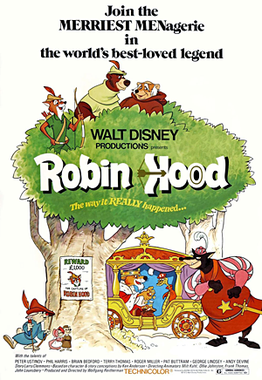
Robin Hood
1973
Directed by Wolfgang Reitherman
Welcome back to Movie Monday! As we do every first Monday of the month, we’re taking a respite from cinematic catastrophes to enjoy a palate cleanser. And unlike last month’s selection, this time I actually mean it. We’re diving into Disney’s 1973 release Robin Hood—a film that holds a special place in my heart despite its obvious flaws, and one that I’d argue deserves far more credit than it typically receives.
Let me be upfront: I love this movie. Always have. It was a staple of my childhood VHS rotation, one of those films I could watch repeatedly without complaint. And here’s the thing—after revisiting it as an adult with a more critical eye, I still love it. Yes, it has problems. Yes, it’s built partially on recycled animation and creative shortcuts. But Robin Hood succeeds where it matters most: it tells a compelling story with memorable characters, genuine emotional stakes, and an infectious sense of fun that makes its 83-minute runtime feel effortless.
The Fox and the Legend
The legend of Robin Hood has been told and retold countless times across every medium imaginable. It’s one of those stories that seems infinitely adaptable—you can set it anywhere, reimagine the characters however you like, and as long as you keep the core themes of standing up for the oppressed against corrupt authority, you’ve got something that resonates. Disney’s genius move was to populate their version with anthropomorphic animals, turning the heroic outlaw into a clever fox, his best friend into a bear, and the villain into a scrawny, mane-less lion who throws tantrums like a spoiled child.
This wasn’t the film’s original conception. Ken Anderson initially pitched setting the story in the American Deep South, hoping to recapture some of the spirit of Song of the South. Thank goodness cooler heads prevailed and kept the traditional English setting. What we got instead was Medieval England populated by animals who perfectly embody their roles: Robin as the sly fox, Maid Marian as his elegant vixen counterpart, Little John as the big lovable bear, Prince John as the weak cowardly lion living in his brother’s shadow, and Sir Hiss as the slithering snake whispering in his ear.
The Music of Nottingham
Let’s talk about what makes Robin Hood work, starting with Roger Miller’s contributions. Miller, already a country music star, composed several songs for the film and voiced Alan-a-Dale, the rooster minstrel who narrates our story. His laid-back, folksy delivery gives the film a distinctive tone—this isn’t grand epic storytelling, it’s a yarn being spun by a wandering musician, and that framing device works beautifully.
“Oo-De-Lally” is pure earworm material, the kind of song that gets stuck in your head for days after hearing it. It perfectly captures the carefree spirit of Robin and Little John’s friendship. “Whistle Stop,” which plays over the opening credits, is so catchy that it was unknowingly stolen decades later for the Hamster Dance website, one of the internet’s earliest viral sensations. (If you were online in the late ’90s and remember those dancing hamsters, congratulations—you were actually listening to sped-up Roger Miller.) “Not in Nottingham” provides a melancholy counterpoint, showing us the despair of the overtaxed townspeople. And “Love,” performed by Nancy Adams, gives us one of Disney’s most beautiful romantic ballads, even if it’s not as well-remembered as it should be.
But the crown jewel is “The Phony King of England,” a rousing mock-the-villain song that’s so much fun you almost forget it’s based on a much older, considerably bawdier English folk song. Phil Harris delivers it with infectious enthusiasm, and the sequence that accompanies it—the townspeople celebrating their small victory over Prince John—is one of the film’s highlights, even if (and we’ll get to this) some of the animation is borrowed from other films.
A Romance Worth Rooting For
One area where Robin Hood absolutely excels is the relationship between Robin and Maid Marian. Unlike some Disney romances that feel perfunctory or rushed, this one has history and genuine chemistry. The film establishes that they were childhood sweethearts separated by circumstances—he became an outlaw, she remained in the castle as Prince John’s niece. When Marian wonders aloud if Robin even remembers her, we feel her longing. When Robin stares wistfully into the distance thinking of her, we understand his yearning.
Their reunion at the archery tournament crackles with romantic tension. Robin, disguised as a stork, wins the tournament and the promised kiss from Marian. The moment she recognizes him through his disguise—not because the disguise fails, but because she knows him—is genuinely touching. And when Robin is sentenced to death and Marian pleads for his life, their declarations of love feel earned, not obligatory.
The film even manages to work in a proposal during a chaotic action sequence, which shouldn’t work but absolutely does. As swords clash and arrows fly, Robin asks Marian to marry him, and her immediate acceptance feels like the most natural thing in the world. These aren’t characters falling in love because the script demands it—they’re characters who have always loved each other finally getting their chance to be together.
Monica Evans and Brian Bedford (who replaced Tommy Steele after Steele couldn’t make the character sound heroic enough) have wonderful vocal chemistry. Bedford plays Robin as charming and confident without being arrogant, while Evans’s Marian is refined but never helpless. She has agency in this story, makes her own choices, and holds her own during the climactic escape sequence. It’s a Disney romance that actually feels like a partnership.
The Perfect Villain Duo
Prince John and Sir Hiss are comedy gold, and I will hear no arguments on this point. Peter Ustinov’s performance as the cowardly, thumb-sucking Prince John is an absolute masterclass in voice acting. He makes this pathetic villain somehow simultaneously despicable and hilarious. His constant tantrums, his desperate need for validation (“Mommy!”), his fury when the townspeople mock him with “The Phony King of England”—it’s all perfectly pitched.
The running gag of John sucking his thumb whenever he feels threatened never gets old, and his breakdown when he realizes he’s been robbed—”Robbed! I’ve been robbed!”—is delivered with such impotent fury that you can’t help but laugh. Ustinov also voices King Richard in the film’s brief conclusion, making the contrast between the two brothers even more stark.
Terry-Thomas as Sir Hiss is the perfect foil—the long-suffering advisor who sees through John’s incompetence but remains loyal out of… well, it’s never entirely clear why Hiss sticks around, but his exasperation with John’s stupidity provides some of the film’s best comedic moments. The physical comedy of a snake trying to maintain dignity while being stuffed in baskets, tied in knots, or blamed for every failure is consistently funny.
What makes them work as villains is that they’re not truly threatening in the way that Maleficent or Cruella de Vil are. They’re dangerous because of their positions of power, not because of any particular competence or malevolence. Prince John’s villainy stems from weakness, greed, and childish spite rather than calculated evil. It makes him perfect for a lighter adventure story.
The Merry Band (or Lack Thereof)
One of Wolfgang Reitherman’s decisions that Ken Anderson apparently wept over was streamlining the cast of characters. Reitherman wanted a “buddy picture” in the vein of Butch Cassidy and the Sundance Kid, which meant focusing on Robin and Little John’s friendship rather than including the full cast of Merry Men. Little John was the only one retained as a proper companion, while Friar Tuck became a separate character living in Nottingham rather than one of Robin’s band.
I understand why Anderson was disappointed—there’s rich potential in the Merry Men that goes unexplored here. But I also think Reitherman’s instinct was sound for this particular film. The Robin and Little John relationship is the emotional core of the story. Their friendship is established immediately and never wavers. Little John is loyal, brave, and serves as both comic relief and genuine support. Phil Harris voices him with warmth and humor, even if—and this is a legitimate criticism—he’s essentially playing Baloo the Bear again.
And look, let’s address that elephant in the room. Or rather, that bear. Phil Harris was perfectly cast as Baloo in The Jungle Book, bringing his distinctive voice and laid-back jazz musician persona to create one of Disney’s most memorable characters. Here, as Little John, he’s doing the exact same thing. Same vocal patterns, same personality, same “don’t worry, be happy” philosophy. Little John even gets to sing the big party number just like Baloo did.
Does it work? Yes, because Phil Harris is inherently charming and the character is written well enough to stand on his own. Does it feel a bit lazy? Also yes. It’s impossible not to notice you’re essentially watching Baloo in a different costume, especially when the film already has enough animation recycling issues (we’re getting there, I promise). But Harris delivers the goods, and the Robin/Little John dynamic is strong enough that it doesn’t sink the film.
The Elephant in the Animation Cel
Okay, let’s talk about the animation recycling, because we have to. Robin Hood is notorious among Disney fans for reusing animation from previous films. Those dancing animals during “The Phony King of England”? Traced from The Jungle Book and The Aristocats. Some of Maid Marian’s movements? Lifted from previous Disney leading ladies. The football sequence during the archery tournament? Borrowed from The Jungle Book. Once you know it’s there, you can’t unsee it.
The reasons for this are well-documented. Disney was in a transitional period following Walt’s death, budgets were tight, and production fell behind schedule. The animation team had no choice but to recycle sequences to meet their deadline. It’s a symptom of a studio struggling to find its footing in a post-Walt world, cutting corners to stay afloat.
Here’s my take: yes, it’s noticeable, and yes, it’s a legitimate flaw. But it doesn’t ruin the film. Here’s why.
First, the recycled animation is primarily in the musical and action sequences—moments where dynamic movement matters more than unique character expression. Is it ideal? No. Does it fundamentally undermine the storytelling? Also no. The sequences where character and emotion matter most—Robin and Marian’s reunion, Prince John’s tantrums, the quiet moments between scenes—those are original, and they’re done well.
Second, the new animation in the film is genuinely charming. The character designs are distinctive and expressive. Robin’s cocky swagger, Marian’s grace, Prince John’s cowardice—these come through in every frame. The xerography process that gave 101 Dalmatians its sketchy look and worked adequately in The Jungle Book is used effectively here, giving the film a storybook quality that suits the fairy-tale nature of the Robin Hood legend.
Third, and most importantly, the film succeeds as a complete work despite this technical limitation. Would Robin Hood be better with entirely original animation throughout? Of course. But the story it tells, the characters it creates, and the emotional journey it takes us on work regardless. Sometimes a film’s strengths can compensate for its weaknesses, and that’s the case here.
Structure and Stakes
Unlike The Aristocats, which felt aimless and episodic without purpose, Robin Hood has clear structure and escalating stakes. Act One establishes Robin as a heroic outlaw and sets up Prince John as the oppressive villain. Act Two brings Robin and Marian together while showing the increasingly desperate plight of Nottingham’s citizens. Act Three delivers on both the action and emotional fronts with a tense rescue sequence and a satisfying resolution.
The film understands that we need to care about what happens to these characters. When Prince John triples the taxes and throws the entire town in jail, we feel the injustice. When Friar Tuck finally snaps and attacks the Sheriff after watching his church’s poor box being emptied, we cheer for him. When Robin risks everything to save the townspeople from Prince John’s execution trap, the stakes feel real.
The climax—Robin trapped in the burning castle trying to save little Tagalong rabbit—generates genuine tension. Yes, we know Robin will survive, but the film makes us worry anyway. His leap from the tower into the moat is beautifully animated and legitimately thrilling. And the ending, with King Richard’s return bringing justice and Robin and Marian’s wedding, provides the satisfying conclusion that this kind of adventure demands.
The Perfect Blend
What Robin Hood gets right is the balance between humor and heart, between adventure and romance, between being a children’s film and being sophisticated enough for adults to enjoy. It never talks down to its audience or assumes kids can’t handle complexity or emotion. The humor comes from character rather than cheap slapstick (though there’s some of that too). The action sequences are exciting but never truly frightening. The romance is sweet but never saccharine.
It’s also a film about something. At its core, Robin Hood is about standing up to corrupt authority, about protecting those who can’t protect themselves, about the powerful exploiting the powerless. Prince John’s overtaxation of Nottingham’s citizens isn’t just a plot device—it’s a real form of oppression that causes real suffering. The film shows us poverty, shows us families unable to feed their children, shows us the dignity stripped from good people by unjust rulers.
When Otto the blacksmith has to donate the single farthing his children gave him for his birthday because the Sheriff demands it, we understand what tyranny looks like on a human (well, animal) scale. When the mouse sexton and his wife can barely afford candles for the church, we see how injustice trickles down. And when Robin redistributes wealth back to these struggling families, we understand why he’s a hero—not because he’s skilled with a bow, but because he uses those skills to help others.
Underrated and Undervalued
Robin Hood received mixed reviews upon release and has never been considered one of Disney’s top-tier animated classics. Critics complained about the recycled animation and compared it unfavorably to the studio’s earlier work. Rotten Tomatoes gives it a 58% rating. It’s dismissed as a lesser effort from Disney’s “Dark Age” of animation.
I think that assessment is fundamentally wrong.
Yes, Robin Hood has technical limitations and budgetary constraints visible on screen. Yes, it’s not as ambitious as Sleeping Beauty or as groundbreaking as Snow White. But it accomplishes exactly what it sets out to do: tell a rollicking adventure story with memorable characters, excellent music, genuine humor, and real heart. It’s enormously entertaining, endlessly rewatchable, and has earned its status as a cult classic for good reason.
The film was a box office success, earning $33 million worldwide against a $5 million budget, and it set records for Disney’s foreign box office at the time. It’s been released and re-released on home video more times than almost any other Disney film. It inspired a generation of animators—Byron Howard, director of Zootopia, cited it as his favorite childhood film and a major influence on his work. And yes, it inadvertently helped inspire the furry fandom, though we’re not going to dwell on that particular legacy.
The Verdict
Robin Hood is proof that a film can overcome its production limitations through the strength of its storytelling, characters, and heart. It’s a film made by a studio in transition, working with less time and money than they needed, trying to figure out their identity in a post-Walt world. That they created something this charming, this entertaining, and this emotionally resonant is a testament to the talent and dedication of everyone involved.
Is it Disney’s best animated feature? No. Is it even in the top ten? Probably not. But it’s a film that understands what makes Robin Hood’s legend endure across centuries—the appeal of standing up to bullies, of fighting for those who can’t fight for themselves, of love conquering circumstance, of friendship and loyalty and doing what’s right even when it’s dangerous.
It’s also just plain fun. The characters are delightful, the music is catchy, the action is exciting, and the romance actually works. It knows when to be funny and when to be serious, when to move and when to let moments breathe. It respects its audience and trusts them to engage with themes of justice and oppression while also enjoying the spectacle of a fox outwitting a lion.
Robin Hood succeeds where it matters most. It may be built partially on borrowed animation, but the story it tells is all its own. And that story, dear readers, is worth telling.
So yes, this is a palate cleanser—not just from bad movies, but from cynicism about Disney’s so-called “Dark Age.” Robin Hood proves that even during difficult transitional periods, magic can still happen. You just have to look for it.
What are your memories of Robin Hood? Does it hold up for you, or has time dulled its charm? And can anyone else still hear the Hamster Dance in their head whenever “Whistle Stop” plays? Let me know in the comments below. Until next Monday, when we return to our regularly scheduled disasters, remember: Oo-De-Lally, life is indeed a merry-go-round, and sometimes the ride is worth taking.
 The Confusing Middle
This post is such a good love letter to what is legitimately one of my favourite Disney films.
Reused drawings shmawings, I couldn’t care less. It’s such a charming wee number.
Like you, I had it on vhs but it had been recorded off the telly so I have strong memories of the adverts too. There was one for Weetabix where it was Robin Hood too.
I rewatched this again in uni. I was studying a module on Richard the lionheart and the third crusade. Can confirm king Johns portrayal was well done and on par with his peers assessment of him.
Thanks for reminding me of this special film
LikeLiked by 1 person