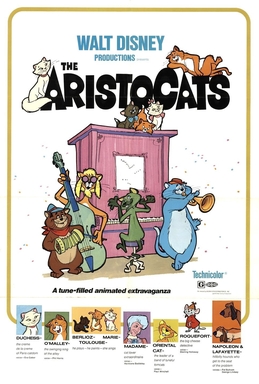
The Aristocats
1970
Directed by Wolfgang Reitherman
Welcome back to Movie Monday! As we do every first Monday of the month, we’re taking a brief respite from cinematic catastrophes to enjoy a palate cleanser. Though “enjoy” might be too strong a word for today’s selection. We’re examining Disney’s 1970 release The Aristocats—a film that holds the dubious distinction of being both the first Disney animated feature completed after Walt’s death and, in this writer’s humble opinion, the absolute nadir of Disney’s animated canon.
I need to apologize upfront to anyone for whom The Aristocats is a cherished childhood classic. I know you’re out there, and I respect your nostalgia. But dear readers, this is my least favorite Disney animated feature of all time. Not “one of” my least favorites. THE least favorite. I would gladly watch The Jungle Book on repeat for 24 hours straight before voluntarily sitting through The Aristocats again. Heck, I’d rather watch Chicken Little or Home on the Range—at least those failures are interesting in their wrongness. The Aristocats commits the greatest sin a piece of entertainment can commit: it’s boring.
The Ghost in the Machine
The Aristocats occupies a peculiar place in Disney history—it’s the first animated feature released after Walt Disney’s death, though he did approve the project and Ken Anderson’s preliminary sketches before passing. This makes it less “the first film without Walt” and more “the last film with Walt’s fading fingerprints,” a distinction that somehow makes the film’s mediocrity even more depressing.
You can feel Walt’s influence in the broad strokes—the talking animals, the villain motivated by inheritance greed, the journey-home narrative structure that echoes Lady and the Tramp and 101 Dalmatians. But it’s like looking at a photocopy of a photocopy; all the essential information is there, but the life has been drained out of it. The film feels less like a creative vision and more like an algorithm trying to replicate Disney magic by combining successful elements from previous films without understanding why those elements worked.
The animation recycling that began as a cost-cutting measure in The Jungle Book reaches almost parodic levels here. Those dancing cats during “Ev’rybody Wants to Be a Cat”? They’re traced from The Jungle Book‘s dancing bears. Duchess’s movements? Often lifted directly from previous Disney leading ladies. Even the countryside dogs Napoleon and Lafayette are essentially recycled animation from 101 Dalmatians. It’s one thing to reuse animation as an economic necessity; it’s another to do it so blatantly that even children notice they’ve seen these exact movements before.
A Plot as Thin as Crème
The story, such as it is, could be written on a cocktail napkin with room to spare. Wealthy Madame Adelaide Bonfamille plans to leave her fortune to her cats. Her butler Edgar, displaying the kind of mathematical incompetence that would make a kindergartener blush, calculates that he’ll be dead before inheriting anything (despite the fact that cats live maybe 15 years, and he’s clearly got at least 30 years left in him). So he drugs the cats and dumps them in the countryside. They meet an alley cat named Thomas O’Malley, who helps them get home. Edgar tries to ship them to Timbuktu. The other cats help. Edgar gets shipped to Timbuktu instead. The end.
That’s it. That’s the movie. There’s no character development, no thematic resonance, no emotional stakes beyond “will these pampered cats get home to their cushions?” The film runs a mercifully brief 78 minutes, yet somehow feels longer than Lawrence of Arabia.
The episodic nature that felt organic in The Jungle Book—where each encounter taught Mowgli something about himself or his place in the world—here feels like padding. The cats meet some geese. Why? Because the movie needs to be longer than 45 minutes. They encounter O’Malley’s jazz-playing alley cat friends. Why? Because someone remembered that cats and jazz were both popular. Every sequence feels disconnected from every other sequence, like a variety show where none of the acts are particularly good.
The Music of Mediocrity
Let’s talk about the music, though I’d rather not. While The Jungle Book‘s songs have become standards—you can’t escape “The Bare Necessities” if you try—The Aristocats‘ musical offerings are immediately forgettable. “Ev’rybody Wants to Be a Cat” is supposedly the film’s showstopper, the one everyone remembers, but it’s a poor man’s “I Wanna Be Like You” without Louis Prima’s manic energy or the Sherman Brothers’ clever wordplay.
The song is also where the film’s problematic elements are most glaring. The Siamese cat playing the piano with chopsticks while singing in a grotesque accent? Disney would later add content warnings to the film specifically because of this character, and rightfully so. It’s not just that it’s offensive—though it certainly is—it’s that it’s lazily offensive, recycling stereotypes from Lady and the Tramp‘s Siamese cats without even attempting to disguise them.
Maurice Chevalier coming out of retirement to sing the title song should be a highlight, but instead, it feels like elderly exploitation. The Sherman Brothers’ rejected songs for this film were supposedly quite good, but they were replaced with forgettable offerings from other composers. “Scales and Arpeggios,” sung by the kittens and Duchess, is meant to be charming but comes off as precious in the worst way. It’s the kind of song that makes you understand why some people hate musicals.
Paris Through American Eyes (Barely Through Anything, Really)
The film is set in Paris, 1910, though you’d barely know it from what’s on screen. Disney’s Paris here isn’t even the romanticized American tourist version—it’s barely Paris at all. We get a few shots of the Eiffel Tower in the distance, some vaguely French countryside, and that’s about it. Compare this to the loving detail of London in 101 Dalmatians or even the stylized but evocative jungle of The Jungle Book. The backgrounds in The Aristocats look like they were painted by someone who had seen a postcard of France once, several years ago, while drunk.
This matters because setting should be character, especially in a film with such a thin plot. Paris in 1910 was the height of the Belle Époque, a time of incredible artistic and cultural fermentation. The film gestures at this with its jazz cats (never mind that jazz wouldn’t really hit Paris until after World War I), but does nothing with it. The cats could be trying to get home to Peoria for all the difference the setting makes.
Characters in Search of Personality
Phil Harris voices Thomas O’Malley, essentially playing Baloo again but without the charm. Where Baloo’s devil-may-care attitude was tempered with genuine affection for Mowgli, O’Malley is just… there. He’s a smooth-talking alley cat who helps because the script needs him to. His romance with Duchess happens because, well, we need a romance, don’t we?
Eva Gabor’s Duchess is perhaps the most frustrating character because she’s almost interesting. A refined cat who must navigate the rough world outside her pampered existence? There’s potential there! But the film does nothing with it. She never really struggles, never really changes, never really does anything except worry prettily and wait for O’Malley to solve her problems.
The kittens—Toulouse, Marie, and Berlioz—are supposedly characterized by their artistic interests (painting, singing, and piano, respectively), but these traits are barely sketched in and have no bearing on the plot. They’re not characters; they’re moving props with names.
Edgar, our villain, makes me long for the complex motivations of Cruella de Vil. At least she had style and conviction. Edgar is just stupid—his plan makes no sense, his execution is incompetent, and his ultimate defeat feels less like comeuppance and more like mercy killing a character who should never have existed.
The Wasted Voices
The film boasts an impressive voice cast—Phil Harris, Eva Gabor, Sterling Holloway, Scatman Crothers (replacing Louis Armstrong, in a story that deserves its own examination of Hollywood’s racial politics), Hermione Baddeley—but wastes them all. These are talented performers given nothing to perform.
The saddest waste is Scatman Crothers as Scat Cat. Brought in to imitate Louis Armstrong after Armstrong had to drop out due to illness, Crothers does his best, but the film gives him nothing to work with. His big number is a retread, his character is a stereotype, and his considerable talents are squandered on material that would have been dated in 1950, let alone 1970.
Animation By Obligation
The film looks tired. That’s the best way I can describe it. The xerography process that gave 101 Dalmatians its distinctive sketchy charm and worked adequately for The Jungle Book here looks cheap and rushed. The character designs are uninspired—the cats look like cats, which sounds like a given, but compare them to the distinctive character designs of Lady and the Tramp‘s dogs or The Jungle Book‘s animals, and you’ll see what I mean.
The action sequences, such as they are, lack any sense of dynamism or danger. When Edgar first attempts to dispose of the cats, the scene with the dogs Napoleon and Lafayette is meant to be comedic but plays as desperate padding. The final confrontation is so perfunctory it barely registers as a climax.
A Studio in Decline
What makes The Aristocats so frustrating is that it represents not just a bad film but a studio in creative free fall. This is Disney animation at its most mercenary, its most calculating, its most creatively bankrupt. Every decision feels like it was made by committee, every creative choice the safest possible option.
The film’s success—and it was successful, becoming the most popular film in France in 1971—only makes things worse. It told Disney that audiences would accept mediocrity as long as it had the Disney name attached. The next decade of Disney animation, often called the Bronze Age or the Dark Age, would be marked by films that felt increasingly desperate and disconnected from what made Disney special.
The Gender Politics of Pampered Cats
We need to talk about Marie, the female kitten, whose entire personality is “I’m a lady.” She’s constantly getting her brothers in trouble by playing damsel in distress, most notably when she deliberately falls in the river so she can be rescued. The film plays this as cute. It’s not cute. It’s teaching little girls that helplessness is adorable and manipulation is romantic.
Duchess herself, despite being the film’s ostensible protagonist, has no agency whatsoever. She doesn’t save her kittens—O’Malley does. She doesn’t defeat Edgar—O’Malley and his friends do. She doesn’t even make the decision to return home—she’s just swept along by events. Her big character moment is deciding to accept O’Malley’s proposal, which was never really in doubt anyway.
Why This Matters
You might wonder why I’m being so hard on a harmless children’s film from 1970. It’s because The Aristocats represents something insidious: the moment when Disney stopped trying to create art and started manufacturing product. Every Disney film that followed would have to fight against the precedent The Aristocats set—that good enough was good enough.
The film’s flaws aren’t interesting flaws. The Black Cauldron is a failure, but it’s a fascinating failure that tried something different. Atlantis: The Lost Empire doesn’t quite work, but you can see the ambition. The Aristocats doesn’t even fail in an interesting way. It just… exists. It’s content to be a moving picture that will distract children for 78 minutes without ever attempting to engage, inspire, or entertain them.
The Final Insult
Here’s the thing that really gets me: The Aristocats could have been good. A story about a family of pampered pets learning to survive in the real world, set against the backdrop of Belle Époque Paris, with jazz music and class consciousness themes? That’s a great concept! But the film has no interest in exploring any of these possibilities. It’s like being handed the ingredients for a gourmet meal and choosing to make instant ramen instead—and not even good instant ramen.
Watching The Aristocats today is like looking at a tombstone marking where Disney’s Golden Age definitively ended. Not with a bang, not even with a whimper, but with a shrug. It’s a film that asks nothing of its audience and gives even less in return.
So no, The Aristocats is not a palate cleanser. If anything, it makes me long for the honest incompetence of the terrible films we usually examine. At least Big Momma’s House—which we’ve already covered—knows what it is and commits to it. The Aristocats is just Disney on autopilot, and the autopilot is malfunctioning.
What are your thoughts on The Aristocats? Am I being too harsh on what many consider a childhood classic? Or do you agree that this represents Disney at its most creatively bankrupt? Let me know in the comments below—I’m genuinely curious if anyone can mount a defense of this film that might change my mind. Until next Monday, when we return to our regularly scheduled disasters with The Incredible Mr. Limpet, remember: not everybody wants to be a cat, and that’s perfectly fine.
 The Confusing Middle
autopilot still lands things 😉
LikeLiked by 1 person
The Aristocats isn’t one of the best Disney movies (it was the Dark Ages after all), but I do think you’re being a little too harsh. I watched it more than a few times when I was a kitten and I promise my brother and I couldn’t stop singing “Everybody Wants to Be a Cat.” It doesn’t hold up that great, but like The Jungle Book, I feel like Walt Disney wanted another carefree animal romp by approving it before he passed away. You already mentioned The Black Cauldron, Home on the Range, and Chicken Run as low points that you got more out of, but can I assume you haven’t seen anything recent from Disney Animation? Because Wish is significantly more creatively bankrupt. Though Strange World is my pick for worst Disney animated movie I’ve ever seen. Even Ralph Breaks the Internet has started to feel like a soulless corporate product that I forced myself to like more than I did at the time of its release. If nothing else, I’m curious to hear your thoughts on the rest of Disney’s Dark Ages.
LikeLiked by 1 person
Robin Hood will get a much better take from me. And I haven’t seen the newest animation from Disney. I’m thinking the most recent one I’ve seen is Encanto. Those others, I hadn’t heard great things, so I haven’t made time for them in n Disney+.
LikeLiked by 1 person
Since I have until July before you review The Black Cauldron, I might as well tell you now that it’s the only Disney Animation Studios movie (aside from Saludos Amigos) that I didn’t watch when I was a kid. So I have no personal attachment to it whatsoever.
LikeLiked by 1 person