Every time I see a headline about scientists successfully extracting ancient DNA or making breakthroughs in de-extinction technology, I can’t help but think: Haven’t we literally watched this movie? Multiple times, in fact. Yet here we are in 2025, with researchers seriously discussing mammoth cloning and genetic resurrection while seemingly having learned nothing from Steven Spielberg’s 1993 masterpiece Jurassic Park—a film that serves as perhaps cinema’s most effective cautionary tale about the dangers of scientific hubris.
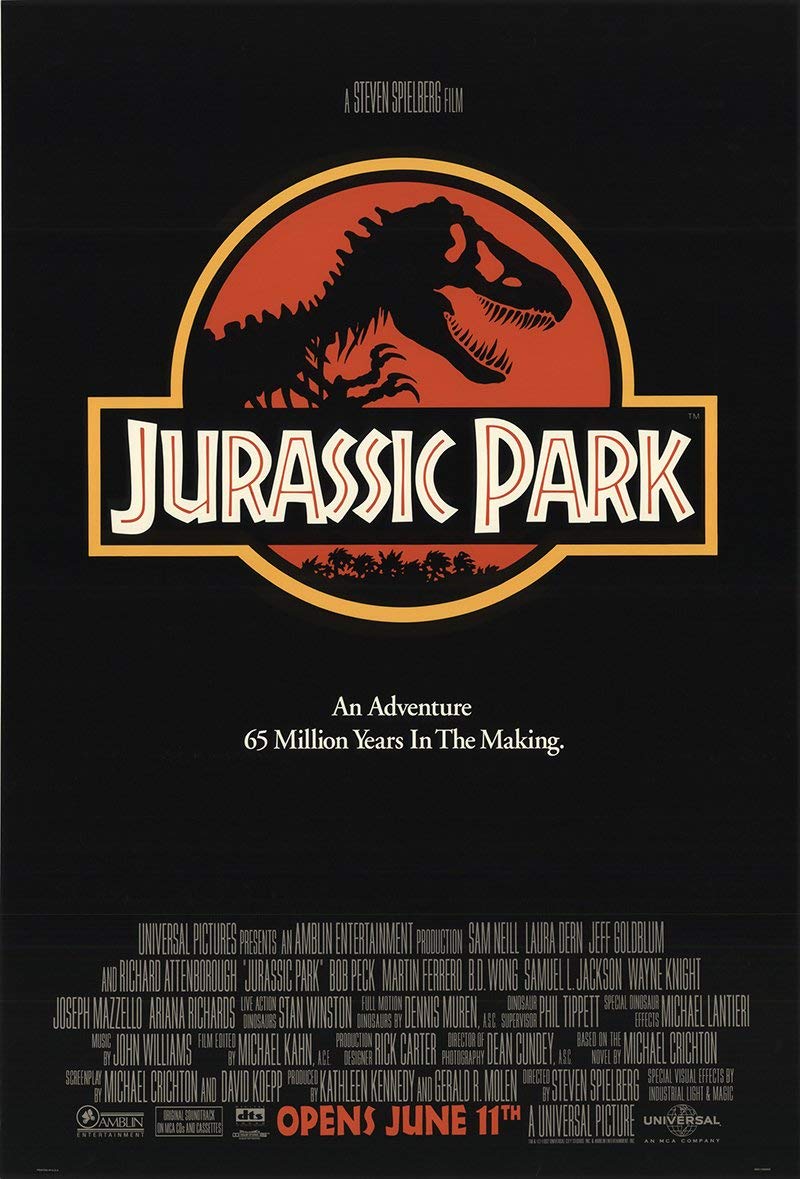
Based on Michael Crichton’s 1990 novel, Jurassic Park tells the story of InGen, a bioengineering company that has successfully cloned dinosaurs by extracting their DNA from blood found in prehistoric mosquitoes preserved in amber. Billionaire John Hammond (Richard Attenborough) creates a theme park on the remote island of Isla Nublar, where these genetically resurrected creatures can roam freely as the ultimate tourist attraction. When the park’s systems fail during a preview weekend—thanks to corporate espionage and a healthy dose of chaos theory—paleontologist Alan Grant (Sam Neill), paleobotanist Ellie Sattler (Laura Dern), mathematician Ian Malcolm (Jeff Goldblum), and Hammond’s grandchildren find themselves trapped on an island with hungry predators that were supposed to be extinct 65 million years ago.
On its surface, Jurassic Park is a thrilling monster movie dressed up in cutting-edge special effects. But beneath the spectacular dinosaur action lies a profound meditation on the ethical boundaries of scientific advancement and the catastrophic consequences of unchecked human arrogance. The film’s central thesis, articulated most memorably by Malcolm’s oft-quoted observation that scientists “were so preoccupied with whether they could, they didn’t stop to think if they should,” remains disturbingly relevant three decades later.
The Architect of Arrogance: John Hammond’s “Spared No Expense” Philosophy
John Hammond embodies the dangerous intersection of scientific ambition and corporate capitalism. His approach to genetic engineering is fundamentally consumerist—dinosaurs aren’t miraculous creatures deserving respect and caution, but products to be manufactured, branded, and sold. His repeated mantra of “spared no expense” reveals a worldview that believes any problem can be solved by throwing enough money at it, while simultaneously cutting corners in the areas that matter most.
The film’s screenplay, co-written by Crichton and David Koepp, cleverly contrasts Hammond’s grandiose vision with the practical realities of what he’s actually created. He speaks reverently about “the most advanced amusement park in the entire world,” but runs his operation with a skeleton crew and relies on a single programmer—Dennis Nedry (Wayne Knight)—to maintain the complex computer systems that keep both tourists and dinosaurs alive. When Nedry’s corporate espionage brings down the park’s security systems, Hammond’s careful omission of backup protocols becomes catastrophically clear.
Hammond’s hubris extends beyond mere corner-cutting. His fundamental misunderstanding of what he’s dealing with reveals itself in his casual attitude toward genetic modification. The dinosaurs aren’t recreations of extinct species; they’re genetic chimeras filled with frog DNA to complete damaged sequences. Yet Hammond presents them as authentic prehistoric creatures, demonstrating either willful ignorance or deliberate deception about the unpredictable nature of his hybrid creations.
The character represents a particularly American brand of technological optimism—the belief that innovation and entrepreneurship can overcome any natural limitation. Hammond doesn’t see himself as playing God; he sees himself as improving on God’s work, making dinosaurs “better” by engineering them to be controllable and profitable. This perspective blinds him to the ethical implications of his work and the inherent dangers of biological systems he doesn’t fully understand.
The Enabler: Dr. Henry Wu and the Normalization of Genetic Manipulation
Dr. Henry Wu (BD Wong), InGen’s chief geneticist, represents the scientific establishment’s complicity in ethically questionable research. In his brief but crucial scene explaining the cloning process, Wu demonstrates how technical expertise can become divorced from ethical consideration. His matter-of-fact explanation of filling genetic gaps with amphibian DNA treats one of the most momentous scientific achievements in human history as routine laboratory work.
Wu’s casual mention that “all the embryos are female” reveals the scientists’ attempt to control reproduction through genetic manipulation—a perfect example of how hubris manifests in the assumption that complex biological systems can be engineered like mechanical devices. The subsequent revelation that the dinosaurs have been changing sex and breeding demonstrates the fundamental flaw in this thinking: life, as Malcolm observes, “finds a way.”
The character embodies the dangerous tendency of specialists to focus on technical problems while ignoring broader implications. Wu is brilliant at genetic engineering but seems entirely unconcerned with questions of whether his work should be done at all. His scientific detachment allows him to participate in potentially catastrophic research while maintaining the comfortable fiction that he’s simply doing his job.
This dynamic reflects real-world concerns about how specialized scientific knowledge can become compartmentalized, with researchers focusing narrowly on their technical challenges while remaining willfully blind to the broader consequences of their work. Wu’s brief appearance in the original film (though he would return prominently in the Jurassic World trilogy) efficiently establishes how institutional structures can enable ethically questionable research by distributing responsibility across multiple participants.
The Prophet: Ian Malcolm and the Mathematics of Inevitable Failure
Dr. Ian Malcolm serves as the film’s moral and intellectual center, though his warnings are initially dismissed as academic pontificating. Malcolm’s expertise in chaos theory provides him with a unique perspective on the fundamental unpredictability of complex systems—making him the perfect character to articulate why Hammond’s enterprise is doomed from the start.
Malcolm’s famous “life finds a way” speech isn’t just colorful dialogue; it’s a precise articulation of why biological systems resist human control. His observation that “the kind of control you’re attempting simply is… it’s not possible” directly challenges the technocratic assumption that sufficient knowledge and resources can overcome natural limitations. From Malcolm’s perspective, Hammond hasn’t created a theme park; he’s constructed an elaborate failure waiting to happen.
The mathematician’s flamboyant personality and theatrical delivery initially make him appear less credible than his more conventional colleagues, but this characterization serves the story’s thematic purposes. Malcolm represents the kind of interdisciplinary thinking that can identify problems invisible to specialists—he sees the forest while others focus on individual trees. His chaos theory background allows him to understand that small perturbations (like Nedry’s sabotage) can cascade into system-wide failures in ways that no amount of planning can prevent.
Malcolm’s critique extends beyond technical concerns to fundamental questions about humanity’s relationship with nature. His observation that InGen lacks “humility before nature” identifies the core problem with Hammond’s approach: the assumption that superior technology grants the right to resurrect and control forces beyond human understanding. This hubris, Malcolm suggests, is not just dangerous but actively evil—a violation of natural boundaries that inevitably invites catastrophic consequences.
The Pattern of Perpetual Denial
Perhaps the most frustrating aspect of the Jurassic Park franchise is how each subsequent film demonstrates humanity’s inability to learn from previous disasters. The Lost World: Jurassic Park (1997) repeats the original’s mistakes with InGen’s Site B operation, while Jurassic Park III (2001) shows how corporate greed continues to drive people toward dinosaur-infested islands despite multiple previous catastrophes.
This pattern reflects a deeply human tendency to believe that this time will be different—that superior technology, better planning, or more resources will allow us to succeed where others have failed. Each film in the series features characters who are aware of previous disasters but convince themselves that they can avoid similar fates through minor modifications to fundamentally flawed approaches.
The repetitive nature of these failures serves as commentary on how institutional memory fails in the face of potential profits. InGen’s corporate rivals don’t abandon dinosaur research after witnessing its catastrophic results; they simply believe they can manage the risks more effectively. This dynamic mirrors real-world patterns in which dangerous technologies are pursued despite clear evidence of their potential for catastrophic failure.
Contemporary Echoes: From CRISPR to Climate Engineering
The themes explored in Jurassic Park have only become more relevant as genetic engineering has moved from science fiction to laboratory reality. CRISPR gene editing technology now allows researchers to modify DNA with unprecedented precision, while de-extinction projects seriously pursue the resurrection of mammoths, passenger pigeons, and other extinct species. Each advancement brings us closer to the kind of genetic manipulation depicted in Crichton’s fictional world.
Modern biotechnology companies often display the same mixture of scientific ambition and commercial interest that characterized InGen. The race to develop genetic therapies, enhance agricultural yields, and solve environmental problems through biological engineering proceeds with limited consideration of potential unintended consequences. Like Hammond, contemporary researchers and entrepreneurs often focus on the potential benefits of their work while downplaying or ignoring risks that may only become apparent after deployment.
Climate engineering proposals—from atmospheric carbon capture to solar radiation management—exhibit similar patterns of technological hubris. These interventions in complex planetary systems echo Hammond’s confidence in his ability to control biological processes he doesn’t fully understand. The assumption that we can engineer our way out of environmental problems created by previous technological interventions reflects the same mindset that led to InGen’s disasters.
The ongoing development of artificial intelligence provides perhaps the most direct parallel to Jurassic Park‘s themes. AI researchers and technology companies pursue increasingly powerful systems while debating safety measures and ethical guidelines—a dynamic that precisely mirrors the tensions between scientific capability and responsible oversight depicted in the film. The question of whether we’re creating forces beyond our ability to control has moved from science fiction to urgent contemporary debate.
The Persistence of Scientific Hubris
Jurassic Park‘s enduring relevance stems from its recognition that scientific hubris isn’t a character flaw but a systemic problem embedded in how modern research and development operates. The film’s genius lies not in demonizing science itself but in identifying the specific conditions—institutional pressures, commercial interests, specialized knowledge, and technological optimism—that combine to override ethical considerations and prudent caution.
The movie’s most unsettling implication is that Hammond, Wu, and their colleagues aren’t evil or uniquely reckless. They’re intelligent, well-intentioned people operating within systems that reward innovation and risk-taking while punishing excessive caution. This structural analysis makes the film’s warnings more urgent: the problem isn’t individual bad actors but the broader framework within which scientific research operates.
Hammond’s confident assertion that he’s “absolutely certain” his dinosaurs can’t breed demonstrates the kind of certainty that should terrify anyone familiar with the history of technological development. The most dangerous innovations often come from people who are absolutely certain they understand and can control forces that later prove more complex and unpredictable than anticipated.
Life Finds a Way
Thirty-two years after its release, Jurassic Park remains one of cinema’s most effective explorations of scientific ethics precisely because it doesn’t offer easy answers. The film doesn’t argue against genetic engineering or technological advancement; it warns against pursuing such developments without adequate consideration of their broader implications and potential for unintended consequences.
Malcolm’s chaos theory provides the film’s central insight: complex systems are inherently unpredictable, and the assumption that sufficient knowledge and control can eliminate uncertainty is itself a dangerous form of hubris. This lesson applies equally to genetic engineering, artificial intelligence, climate intervention, and any other technology that promises to solve fundamental problems through technical innovation.
The movie’s enduring power lies in its recognition that the drive to push beyond natural boundaries is fundamentally human—and fundamentally dangerous when divorced from humility, ethical consideration, and respect for the complexity of the systems we’re attempting to modify. As we continue developing technologies that would have seemed like science fiction in 1993, Jurassic Park‘s warnings about the consequences of unchecked scientific ambition remain as relevant as ever.
Perhaps the most sobering lesson from Hammond’s failed experiment is that good intentions and advanced technology are insufficient safeguards against catastrophic failure. The road to extinction, it turns out, is paved with spare-no-expense budgets and absolute certainty about our ability to control forces beyond our understanding. In our current era of rapid technological advancement, we would do well to remember that some boundaries exist for very good reasons—and that life, indeed, finds a way around even our most carefully constructed safeguards.
What aspects of scientific hubris in Jurassic Park resonate most strongly with contemporary technological developments? Share your thoughts in the comments below.
 The Confusing Middle