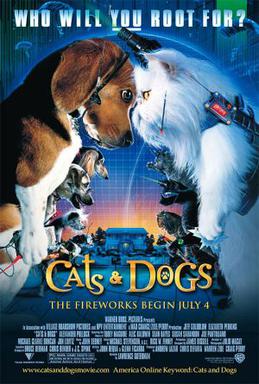
2001
Directed by Lawrence Guterman
Welcome back to Movie Monday, where we’re steadily working our way through my personal countdown of the 100 worst movies I’ve ever had the misfortune to sit through. This week we’re unleashing number 44: Cats & Dogs, the 2001 spy comedy that took the innocent concept of household pets having a secret war and somehow transformed it into a cinematic experience so aggressively mediocre that it makes you wonder if the filmmakers were allergic to basic storytelling principles. And yes, as always, this represents my personal opinion. If you found genuine entertainment value in watching CGI animals deliver dialogue with all the enthusiasm of grocery store employees reading their mandatory safety training, then we clearly have different standards for what constitutes quality family entertainment.
I’ll admit, when Cats & Dogs was first announced, the premise had potential. The idea of our beloved pets secretly waging an elaborate espionage war while we humans remain blissfully unaware is the kind of high-concept family comedy that could work in the right hands. It’s Homeward Bound meets Mission: Impossible, with just enough absurdity to appeal to children while offering opportunities for clever humor that adults could appreciate. The film even boasted an impressive voice cast including Tobey Maguire, Alec Baldwin, Sean Hayes, and Susan Sarandon – actors who had proven their comedic chops in other projects. What could possibly go wrong?
As it turns out, everything. Cats & Dogs manages the impressive feat of taking a genuinely entertaining premise and systematically destroying every element that could have made it work. It’s like watching someone receive a beautifully wrapped gift and then immediately set it on fire while complaining that presents are stupid.
From Clever Concept to Catastrophic Execution
The central premise of Cats & Dogs – that household pets are engaged in a secret war for global supremacy – is inherently ridiculous, but ridiculous in exactly the right way for a family comedy. The setup allows for elaborate spy gadgets, over-the-top villains, and the kind of physical comedy that should translate perfectly to a movie about animals with opposable thumbs and serious attitude problems.
The film follows Lou (voiced by Tobey Maguire), a beagle puppy who accidentally becomes recruited into the dogs’ secret intelligence network when he’s adopted by the Brody family. Professor Charles Brody (Jeff Goldblum) is on the verge of developing a cure for human allergies to dogs, which naturally threatens the cats’ long-term plan for world domination. Led by the villainous Mr. Tinkles (Sean Hayes), a Persian cat with delusions of grandeur and a serious persecution complex, the feline forces will stop at nothing to steal the formula and finally achieve their dream of ruling over their human servants.
It’s a setup that practically writes itself – or at least, it should have been. The concept provides built-in conflict (cats versus dogs), clear stakes (the fate of human-pet relationships), and endless opportunities for physical comedy (imagine the training montages alone). A competent family film could have mined this premise for genuine laughs while creating characters that both children and adults could invest in emotionally.
Instead, Cats & Dogs feels like it was written by someone who heard the concept described at a party, forgot most of the details, and then tried to reconstruct the story from memory while suffering from a severe head cold. The result is a movie that somehow makes secret agent animals boring – an achievement that requires a special kind of creative incompetence.
Voice Acting That Sounds Like a Dial Tone
One of the most immediately apparent problems with Cats & Dogs is the uniformly lifeless voice acting from a cast that should have been capable of so much more. Tobey Maguire, fresh off his success in The Cider House Rules and on the verge of becoming Spider-Man, delivers Lou’s dialogue with all the energy and enthusiasm of someone reading a phone book to an empty room. There’s no sense of discovery, wonder, or even basic personality in his performance – just a series of lines delivered with the mechanical precision of a GPS navigation system.
Alec Baldwin, an actor known for his sharp comedic timing and ability to find humor in the most mundane situations, phones in his performance as Butch, the grizzled veteran dog agent assigned to train Lou. Baldwin has proven in countless other projects that he can bring wit and charisma to even the most thankless roles, but here he sounds like he’s recording his lines during a lunch break between more important projects. The character of Butch should be a perfect fit for Baldwin’s natural screen presence – the world-weary mentor with hidden depths and a sarcastic exterior – but instead we get dialogue delivery that makes you wonder if the actor was reading his lines for the first time during the recording session.
Sean Hayes fares slightly better as the villainous Mr. Tinkles, primarily because the character’s over-the-top megalomania gives him something to play against. But even Hayes, who had already proven his comedic abilities on Will & Grace, seems constrained by dialogue that feels like it was written by someone who had never actually heard how real people (or even cartoon characters) speak. Mr. Tinkles should be a deliciously evil villain in the tradition of classic animated antagonists, but Hayes delivers the lines with a flatness that drains the fun out of even the most potentially entertaining moments.
Susan Sarandon’s Ivy, the female agent with a mysterious past, suffers from the same endemic problem that affects the entire voice cast – the dialogue is so generic and uninspired that even Oscar-winning actors can’t breathe life into it. Sarandon has demonstrated throughout her career that she can find the humanity in any character, but the script gives her absolutely nothing to work with beyond exposition and plot advancement.
The truly frustrating thing about the voice acting in Cats & Dogs is that it doesn’t have to be this bad. Animated films had already proven that strong voice performances could elevate even mediocre material – look at Shrek, which came out the same year and featured actors clearly having fun with their roles. The difference is that Shrek gave its voice cast characters with distinct personalities and dialogue that sounded like it was written by humans who had actually engaged in conversation at some point in their lives.
Special Effects That Look Unfinished
If the voice acting sounds like the actors were sleepwalking through their performances, the special effects look like the artists were working with one eye closed and both hands tied behind their backs. Even by 2001 standards – a year that saw the release of The Lord of the Rings: The Fellowship of the Ring and Shrek – the visual effects in Cats & Dogs are remarkably unconvincing.
The film’s approach to making animals appear to talk involves a combination of animatronics, puppetry, and early digital effects that never quite gel into a cohesive visual style. The mouth movements rarely sync properly with the dialogue, creating a disconnect that constantly reminds viewers they’re watching a technical exercise rather than a story about living characters. It’s particularly jarring when you consider that talking animal movies had been successfully using various techniques for decades – from the practical effects in Babe to the more sophisticated digital work in Disney’s animated features.
The action sequences, which should be the film’s highlight, suffer from effects work that looks rushed and incomplete. When Butch and Lou engage in high-speed chases or elaborate fight scenes, the compositing is so obvious that the animals appear to exist in a completely different universe from their surroundings. Shadows don’t match, lighting is inconsistent, and the physics of the animal movements often defy basic logic in ways that aren’t charming or fantastical, just sloppy.
Mr. Tinkles’ various schemes involve elaborate mechanical contraptions and secret hideouts that should feel impressive and fantastical. Instead, they look like rejected concept art from a theme park attraction designed on a severely limited budget. The cat agents’ headquarters, the dogs’ secret base, and the various spy gadgets all have the visual weight of cardboard props that might fall over if someone sneezed too hard near the set.
Even more problematic is the film’s inconsistent approach to anthropomorphizing its animal characters. Sometimes the pets behave like normal animals who happen to be able to talk; other times they operate complex machinery and engage in elaborate martial arts sequences that require human-level dexterity. The film never establishes clear rules for what its animal characters can and can’t do, creating a viewing experience that constantly shifts between different levels of reality without any apparent logic.
A Plot That Forgets to Be Entertaining
Beyond the technical failures, Cats & Dogs suffers from a fundamental storytelling problem: it mistakes activity for entertainment. The film is constantly in motion, with characters rushing from one location to another and engaging in elaborate action sequences, but none of this movement serves any real narrative purpose or character development.
Lou’s journey from ordinary puppy to secret agent should be the emotional core of the film, but the script never bothers to establish why we should care about his transformation. He begins the movie as a generic cute puppy and ends as a generic cute puppy who happens to know some spy techniques. There’s no growth, no learning, no moments of genuine triumph or failure that would help audiences invest in his success.
The relationship between Lou and the Brody family, which should provide the emotional stakes for the entire story, feels perfunctory and underdeveloped. Young Scotty Brody (Alexander Pollock) and Lou are supposed to form a bond that drives Lou’s motivation to protect his new family, but their interactions are so brief and surface-level that their connection never feels genuine. When Lou eventually risks everything to save the Brodys, it feels like a plot obligation rather than an emotional necessity.
Professor Brody’s research into dog allergies provides the MacGuffin that drives the plot, but the film never makes the stakes feel real or urgent. We’re told that if the cats succeed in their plan, all humans will become allergic to dogs, but the movie never shows us what this would actually mean for the characters we’re supposed to care about. It’s a global catastrophe that feels entirely theoretical, like a math problem rather than a genuine threat.
Even the film’s action sequences, which should provide visceral excitement even when the plot falters, feel strangely bloodless and consequence-free. Characters engage in elaborate battles and death-defying stunts, but there’s never any sense that anyone is in real danger or that the outcomes matter beyond advancing to the next scene. It’s action for the sake of action, without the stakes or character investment that would make it meaningful.
The Video Game Movie Problem in Reverse
Cats & Dogs suffers from what I call the video game movie problem in reverse. Where video game adaptations typically fail by trying to cram too much game content into a film format, Cats & Dogs takes a simple, elegant concept and somehow fails to fill an 83-minute runtime with meaningful content.
The film feels like it was conceived as a series of loosely connected set pieces – the puppy training sequence, the infiltration of the cat headquarters, the final battle in the laboratory – without anyone bothering to create the connective tissue that would make these scenes feel like part of a cohesive story. Each sequence exists in isolation, like levels in a video game that happen to feature the same characters but don’t build toward any larger narrative or thematic purpose.
This episodic structure might work for a Saturday morning cartoon series, where each episode needs to function as a self-contained unit, but it’s deadly for a feature film that needs to sustain audience interest and investment for an hour and a half. The result is a viewing experience that feels simultaneously rushed and sluggish – rushed because individual scenes feel underdeveloped and truncated, sluggish because the overall story never builds momentum or generates genuine excitement.
The film’s approach to comedy suffers from the same structural problems. Rather than building running gags or developing character-based humor that grows more sophisticated over time, Cats & Dogs relies on isolated moments of physical comedy that rarely connect to anything larger. A cat gets dressed in embarrassing outfits, dogs use high-tech gadgets in amusing ways, animals fall down in exaggerated fashion – but none of these moments add up to create a consistent comedic voice or style.
Family Film or Endurance Test?
Perhaps the most damning thing about Cats & Dogs is how thoroughly it wastes its target audience’s time and intelligence. Family films don’t need to be masterpieces to succeed – they just need to offer genuine entertainment value for both children and the adults who will inevitably be watching alongside them. The best family movies understand that kids are capable of following more sophisticated stories and appreciating more nuanced humor than Hollywood often gives them credit for.
Cats & Dogs takes the opposite approach, assuming that children will be satisfied with bright colors and talking animals regardless of whether those elements are deployed in service of anything resembling entertainment. The film feels like it was made by people who had never actually spent time with children and were working from a checklist of what they imagined kids might want to see.
The movie’s attempts at adult humor are equally misguided, consisting mainly of spy movie references that feel obligatory rather than clever. The film name-drops James Bond and Mission: Impossible without understanding what made those franchises entertaining in the first place, creating “parody” sequences that feel more like homework assignments than genuine comedy.
Even the film’s message about the importance of family and loyalty feels halfhearted and unearned. Lou learns to appreciate his adopted family and the value of teamwork, but these lessons emerge through plot mechanics rather than genuine character development. It’s the kind of moral that gets stated explicitly in dialogue rather than demonstrated through character actions and consequences.
Box Office Success That Proves Nothing
Despite its numerous problems, Cats & Dogs was actually a commercial success, grossing over $200 million worldwide against a $60 million budget. This might seem to contradict my assessment of the film as a failure, but box office success – particularly for family films – often has more to do with marketing, timing, and lack of competition than actual quality.
Cats & Dogs opened during the summer of 2001, when family entertainment options were relatively limited and parents were looking for air-conditioned activities to occupy their children during school vacation. The film’s marketing campaign effectively sold the high-concept premise without revealing how poorly that concept was executed, leading to strong opening weekend numbers that gradually declined as word-of-mouth spread.
The international box office success can be attributed partly to the universal appeal of cute animals and the fact that the film’s dialogue problems are less apparent when viewed with subtitles or dubbing. Physical comedy translates across language barriers more easily than verbal wit, allowing the film to find audiences who might have been more forgiving of its structural and performance issues.
However, the film’s commercial success came at a cost to the broader landscape of family entertainment. Cats & Dogs helped establish a template for lazy, effects-driven family comedies that prioritized marketable concepts over actual storytelling craft. Its success convinced studio executives that audiences would accept subpar family entertainment as long as it featured recognizable elements like talking animals and celebrity voice casts.
Critical Reception: When Even Low Expectations Aren’t Low Enough
The critical response to Cats & Dogs was about as lukewarm as you’d expect for a film this fundamentally uninspired. The movie currently holds a 52% rating on Rotten Tomatoes – not quite “rotten,” but firmly in the realm of “meh” that’s often more damning than outright hatred. At least terrible movies generate passionate responses; mediocre ones just inspire shrugs and forgotten viewing experiences.
Critics consistently noted the film’s wasted potential, with many reviews reading like disappointed parents explaining why their child’s report card was unsatisfactory despite showing flashes of intelligence. The technical problems were universally acknowledged, but what seemed to frustrate reviewers most was the sense that a genuinely entertaining family film was buried somewhere beneath the lazy execution and phoned-in performances.
Roger Ebert, who was often generous toward family films that showed genuine effort even when they fell short of perfection, gave Cats & Dogs a middling review that praised the special effects while noting the film’s failure to develop its characters or premise in meaningful ways. Even positive reviews tended to be qualified endorsements that essentially amounted to “your kids might enjoy it, but don’t expect to have a good time yourself.”
The film’s reception among actual families was similarly mixed, with many parents reporting that while their children seemed entertained during the viewing experience, the movie didn’t generate the kind of lasting enthusiasm or repeat viewing requests that characterize truly successful family entertainment. It was the kind of film that occupied 83 minutes without leaving much impression afterward.
Why Cats & Dogs Earns Its Spot at Number 44
So why does Cats & Dogs land at number 44 on my personal worst movies list? It’s because the film represents a particularly frustrating type of failure – the kind that results from creative laziness rather than ambitious overreach. This isn’t a movie that tried to do something innovative and fell short; it’s a movie that took a concept with obvious entertainment potential and executed it with the minimum possible effort.
The film had everything it needed to succeed: a high-concept premise that immediately communicates its entertainment value, a cast of proven comedic actors, sufficient budget for impressive special effects, and a built-in audience of families looking for quality entertainment. Instead of building on these advantages, the filmmakers seemed content to coast on the assumption that talking animals would be inherently entertaining regardless of what those animals actually did or said.
What makes this particularly maddening is how easily fixable most of the film’s problems would have been. Better dialogue could have been written, more care could have been taken with the special effects, and the voice actors could have been directed to bring more energy and personality to their performances. These aren’t impossible creative challenges; they’re basic elements of competent filmmaking that were simply neglected.
Cats & Dogs also represents the worst tendencies of early 2000s family filmmaking, when studios seemed convinced that technological gimmicks could substitute for actual storytelling. The film prioritizes its (unconvincing) special effects over character development, plot coherence, or genuine humor, creating a viewing experience that feels more like a tech demo than an actual movie.
Most frustratingly, the film’s commercial success helped establish a template for lazy family entertainment that plagued the genre for years afterward. Cats & Dogs proved that audiences would accept subpar family films if they featured marketable concepts and celebrity voice casts, encouraging studios to prioritize high-concept pitches over actual script quality.
The Long-Term Damage: Franchise Futility
The immediate sequel, Cats & Dogs: The Revenge of Kitty Galore, was released in 2010 and somehow managed to be even worse than the original – an achievement that requires a special kind of dedication to mediocrity. The fact that the franchise continued despite the obvious problems with the first film demonstrates how little studios learned from the original’s creative failures.
Even more tellingly, the third film in the series, Cats & Dogs 3: Paws Unite!, was released directly to video in 2020, effectively admitting that the franchise had exhausted whatever theatrical appeal it might have once possessed. When your movie series ends up in the straight-to-video graveyard, it’s usually a sign that something went seriously wrong along the way.
The Cats & Dogs franchise also contributed to a broader trend of family films that prioritized marketable concepts over actual entertainment value. The success of the original convinced studios that talking animal movies were guaranteed money-makers, leading to a flood of similar projects that featured cute animals engaging in human activities without bothering to create compelling reasons for audiences to care about what those animals were doing.
The Bottom Line
Cats & Dogs stands as a monument to squandered potential and creative complacency. It’s a film that had every advantage – a great concept, talented voice actors, sufficient resources, and a built-in audience – and still managed to create something aggressively forgettable.
The movie fails because it confuses concept with execution, celebrity casting with actual performance, and technical effects with genuine magic. It’s a film that seems to have been made by people who thought that simply putting talking animals on screen would automatically result in entertainment, without considering whether those animals had anything interesting to say or do.
In the end, Cats & Dogs is like a beautifully wrapped present that turns out to contain nothing but packing material. All the external elements suggest something special inside, but the actual experience of unwrapping it reveals just how little thought went into what audiences would find when they looked beneath the surface. It’s a movie that makes you appreciate how difficult it is to create genuine family entertainment and how easy it is to waste good ideas through simple creative laziness.
Next week on Movie Monday, we’re taking a break from the worst movies list for our monthly palate cleanser. Join me on December 1st as we explore Disney’s animated classic The Sword in the Stone, a film that reminds us what happens when talented artists take a simple story and execute it with care, creativity, and genuine respect for their audience. Until then, remember: just because you can make animals talk doesn’t mean you should, and sometimes the most disappointing movies are the ones that had no excuse for being bad in the first place.
What are your thoughts on Cats & Dogs? Did you manage to find entertainment value in this phoned-in family film, or do you think it deserves its place among the most frustratingly mediocre movies ever made? Share your experiences in the comments below – I’d love to hear whether anyone out there has a defense for this waste of perfectly good talking animals.
 The Confusing Middle
Cats & Dogs is one of the few movies on your list that I feel I have to defend. I think you’re being a little too harsh. The title tells you exactly what you’re getting and that’s perfectly fine for a family film. I was one of those kids who saw the movie in theaters when I was 6. My brother and I enjoyed it, and we watched it many times after on VHS. The concept being inherently silly makes the cartoonish effects forgivable for me.
Cats & Dogs: The Revenge of Kitty Galore on the other hand, is the movie that deserves all the hate. I was 15 when my brother and I made the mistake of seeing it in theaters. It was a lazy waste of money that ruined anything I liked about the original. I didn’t bother with the direct-to-video sequel since it looks even more lazy.
LikeLiked by 1 person
Sorry… I never saw the sequel, since I didn’t like the original. If I had, I’m sure it would be on the list instead of this one.
LikeLiked by 1 person