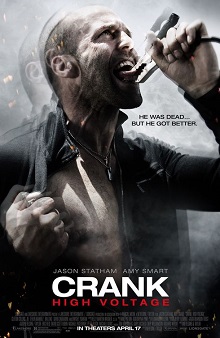
2009
Directed by Neveldine/Taylor
Welcome back to Movie Monday, where we continue our journey through the depths of cinema hell with my personal list of the worst movies I’ve ever seen. Today we’re landing at number 52: Crank: High Voltage, the 2009 sequel that somehow managed to make the original Crank look like a masterpiece of restraint and subtlety. And before you ask—yes, that’s as terrifying as it sounds.
Remember, this list is purely my opinion, so if you happen to love watching Jason Statham attach jumper cables to his nipples while engaging in public sex acts, more power to you. We all have our guilty pleasures. This just isn’t mine.
The Premise: Because Apparently We Needed More
For those fortunate enough to have missed the first Crank (2006), here’s the setup: Chev Chelios (Jason Statham) is a hitman who gets injected with a poison that will kill him if his heart rate drops below a certain level. So he spends 88 minutes running around Los Angeles doing increasingly ridiculous things to keep his adrenaline pumping. It’s Speed meets DOA with a healthy dose of Red Bull-fueled insanity.
The film ends with Chelios falling out of a helicopter and hitting the pavement. Most rational people would assume that’s the end of the story. Death tends to be pretty final, even in action movies. But directors Mark Neveldine and Brian Taylor looked at that splattered corpse and thought, “You know what this needs? A sequel.”
Crank: High Voltage picks up immediately after that fatal fall, with Chelios somehow surviving his concrete facial and being scooped up by Chinese gangsters who harvest his heart and replace it with an artificial one. Because apparently, the laws of physics took a permanent vacation from this franchise. Now instead of needing adrenaline, Chelios needs electrical charges to keep his mechanical heart pumping, leading to 96 minutes of the most ridiculous electrocution-based action sequences ever committed to film.
The Bridge Too Far
Look, I can buy a lot of nonsense in action movies. I can buy John McClane jumping off the roof of the Nakatomi Building tethered by nothing but a fire hose wrapped around his waist. I can buy Dominic Toretto leaping into the air and catching his girlfriend at 70 miles per hour while landing, unharmed, on the windshield of an oncoming vehicle. I can even buy Jason Statham fighting a giant prehistoric shark in the middle of the ocean.
But Jason Statham being kept alive by clamping jumper cables onto himself? That’s a bridge too far, even for me.
The problem isn’t just the scientific impossibility—it’s that the premise forces the entire movie to revolve around increasingly absurd electrical stunts. We watch Chelios rub against strangers to create static electricity, stick his tongue in a car’s cigarette lighter, and eventually grab onto high-voltage power lines while being set on fire. It’s like watching someone play the world’s most dangerous game of Operation.
And don’t get me wrong—I love a good Jason Statham movie. The man can transport packages across Europe while being chased by the entire French police force. He can keep bees and look stoic while doing it. He can even hunt down giant extinct sharks with nothing but a diving cage and British determination. But Crank just isn’t doing it for me. It takes everything that makes Statham great—his physicality, his deadpan delivery, his ability to make the impossible seem plausible—and drowns it in a sea of electrical puns and jump-start jokes.
Production: 300 Hours of Poor Decisions
The making of Crank: High Voltage reads like a masterclass in how to take a bad idea and make it worse. According to the production notes, directors Neveldine and Taylor initially refused to make a sequel, calling the idea “ridiculous” and “kinda lame.” They had a point—they’d literally killed their protagonist at the end of the first film. But somehow, they talked themselves into it, probably while hopped up on the same energy drinks that fuel their visual style.
The duo shot an astounding 300 hours of footage over just 31 days of filming, which breaks down to nearly 10 hours of material per day. That’s not filmmaking; that’s documentation of a collective nervous breakdown. They used “prosumer” HD cameras, with director Mark Neveldine famously filming chase scenes while wearing roller blades, because apparently, traditional filmmaking techniques weren’t chaotic enough for this project.
The result is a movie that looks like it was edited by someone having a caffeine-induced seizure. The film employs every visual trick in the book—rack zooms, split screens, whiplash pans, and enough quick cuts to make a Michael Bay film look contemplative. One critic accurately described it as having “the same Red Bull six-pack aesthetic” as the original, which is both a perfect description and a damning indictment of modern action cinema.
The Cast: Commitment to Chaos
Credit where credit’s due: Jason Statham commits fully to this electrical nightmare. The man performs his own stunts, including scenes where he’s literally set on fire, apparently with “little seeming regard for his own physical well-being.” It’s the kind of dedication that would be admirable if it were in service of a better movie. Instead, it’s like watching a master craftsman use his skills to build an elaborate torture device.
The supporting cast reads like a who’s who of “actors who needed a paycheck.” Amy Smart returns as Eve, Chelios’s girlfriend, and gets to participate in what critics generously called a “borderline pornographic” sex scene on a racetrack. According to Smart herself, the scene involved rolling around in horse dirt while racing fans cheered, which sounds about as pleasant as it was to watch.
David Carradine appears as the villain Poon Dong in one of his final roles before his death, while Dwight Yoakam plays a doctor who apparently learned medicine from the same school as Dr. Frankenstein. The film also features an impressive array of celebrity cameos, including real adult film stars playing themselves in a porn strike subplot, because why not add labor disputes to your already overcomplicated electrical resurrection story?
The Violence: When “More” Isn’t Better
If the original Crank was excessive, High Voltage is excessively excessive. The film features what one critic noted as “perhaps the first pic to feature an anal rape by shotgun,” which is both historically significant and deeply disturbing. The violence isn’t just over-the-top—it’s mean-spirited and nasty in a way that goes beyond typical action movie mayhem.
Critics noted that while the first film treated its cartoon violence as a “sick joke,” the sequel approaches it as “an applied science.” The difference is palpable and unpleasant. Where the original had a certain anarchic charm, High Voltage feels calculated in its offensiveness, as if the filmmakers sat down and asked themselves, “What’s the most shocking thing we can put on screen?”
The film “vigorously abuses Mexicans, Asians, women and the disabled with equal-opportunity glee,” according to New York Times critic Jeannette Catsoulis, who also called it “boorish, bigoted and borderline pornographic.” It’s the kind of movie that mistakes controversy for cleverness and shock value for substance.
The Reception: Critics Were Not Amused
Crank: High Voltage wasn’t screened for critics, which should tell you everything you need to know about the studio’s confidence in their product. When reviews did appear, they were about as brutal as you’d expect. The film earned a 64% on Rotten Tomatoes, which seems generous considering the content, and a more realistic 41/100 on Metacritic.
Variety‘s Rob Nelson called it “Yet another D.O.A. for the ADD era,” while The Guardian‘s Alexander Larman wondered if it might be “the most offensive film in recent memory.” Even critics who tried to find something positive to say struggled. Entertainment Weekly‘s Adam Markovitz called it “an eye-popping strobe of flesh and blood” but admitted it was “polarizing,” which is like calling a nuclear explosion “somewhat warm.”
The film’s visual style came under particular attack. Critics complained about the “choppy” camerawork that made even Jason Statham “barely noticeable” and the “hard light that highlights every skin flaw.” When your cinematography is so aggressive that it makes your action star invisible, you’ve probably made some questionable choices.
The Box Office: Electrical Failure
High Voltage opened in sixth place at the domestic box office, earning just under $7 million in its opening weekend. The film ultimately grossed $34.6 million worldwide against a $13.5 million budget, which sounds profitable until you factor in marketing costs and the fact that the original Crank made $43 million. The sequel actually made less money than its predecessor, which is usually a sign that audiences have had enough of your particular brand of chaos.
The film performed better on DVD, where it found its natural habitat among viewers who could pause the action when it became too overwhelming. Sometimes home video is the perfect venue for a movie that’s essentially a 96-minute endurance test.
The Legacy: Thankfully Brief
Despite talk of a third film and director Brian Taylor once suggesting a 2013 release date for Crank 3, the franchise mercifully died with High Voltage. Jason Statham has expressed interest in returning, but even he seems to understand that some things are better left dead. Unlike his character, some resurrections just aren’t worth the effort.
The film’s main legacy is as a cautionary tale about the dangers of sequel escalation. When your original movie features a man who needs constant adrenaline to survive, where exactly do you go from there? The answer, as High Voltage demonstrates, is nowhere good.
The Verdict: Unplugged
Crank: High Voltage is what happens when filmmakers mistake chaos for creativity and volume for substance. It’s a movie that thinks being louder, faster, and more offensive automatically makes it better, when in reality, it just makes it more exhausting to watch.
The film’s 96-minute runtime feels like an eternity, not because it’s boring, but because it’s relentlessly, aggressively stupid. It’s the cinematic equivalent of being trapped in a room with someone who keeps turning the music up louder because they think that’s the same thing as making it better.
Jason Statham deserves better than this electrical nightmare, and so do audiences. While the Transporter series and The Meg prove that Statham can carry ridiculous action premises with style and charm, Crank: High Voltage demonstrates that even the most committed performance can’t save a fundamentally broken concept.
So there you have it: Crank: High Voltage at number 52 on my worst movies list. It’s a film that took everything wrong with its predecessor and amplified it to painful levels. Sometimes dead is better, and sometimes sequels should just stay buried.
Join me next week for another trip through cinema hell, where we’ll discover what managed to rank even lower than Jason Statham’s electrical adventure. Until then, keep your expectations low and your jumper cables safely in the garage where they belong.
What did you think of Crank: High Voltage? Did it shock you in all the wrong ways, or am I being too harsh on this electrical disaster? Let me know in the comments below, and don’t forget to suggest other terrible movies you’d like to see covered in future Movie Monday posts.
 The Confusing Middle
You may recall that I just reviewed the Crank movies 2 months ago. I was shocked (pun intended) to see High Voltage got a fresh rating on Rotten Tomatoes. Even if it is in the 60’s, that’s still too high for a sequel like this. I accept the first Crank as a guilty pleasure, but I hated how overly offensive and disgusting High Voltage was. Glad to see someone else agrees on that. An endurance test is an understatement.
LikeLiked by 1 person