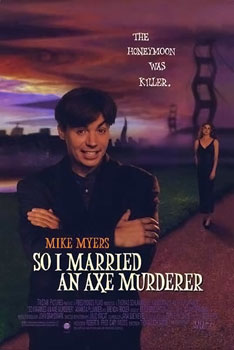
1993
Directed by Thomas Schlamme
Welcome back to Movie Monday, where we continue our journey through my personal list of the 100 worst movies I’ve ever seen. Today we’re landing at number 53 with Mike Myers’ 1993 romantic black comedy So I Married an Axe Murderer. As always, this ranking is purely my opinion—what sends me running for the exit might be your guilty pleasure, and that’s perfectly fine. We’re all entitled to our questionable taste in cinema.
After the massive success of Wayne’s World in 1992, Mike Myers was Hollywood’s golden boy, and studios were eager to throw money at whatever he wanted to do next. What he wanted, apparently, was to play both a commitment-phobic beat poet named Charlie MacKenzie and his Scottish father Stuart in a murder-mystery-romance that asks the burning question: “What if your new girlfriend might be a serial killer, but she’s really sweet and works at a butcher shop?”
It’s a premise that could work—Hitchcock certainly knew how to blend romance with murder, and black comedies have a proud tradition when done well. Unfortunately, So I Married an Axe Murderer feels like it can’t decide what it wants to be, resulting in a tonal mess that somehow manages to make Nancy Travis—arguably one of the most wholesome actresses of the 1990s—seem like a plausible suspect for chopping up husbands with an axe.
The Plot That Shouldn’t Work (And Doesn’t)
Charlie MacKenzie is San Francisco’s least convincing beat poet, a guy who treats his relationships like disposable coffee cups and turns every breakup into material for his painfully pretentious poetry readings. When he meets Harriet Michaels, a butcher shop worker played by Nancy Travis, Charlie thinks he’s found “the one”—until a tabloid story about a serial killer known as “Mrs. X” makes him paranoid that his new girlfriend might be collecting husbands like stamps.
The fundamental problem here is casting. Nancy Travis radiates the kind of warm, maternal energy that makes you want to bake cookies with her, not flee in terror. Asking audiences to believe she could be a cold-blooded killer is like casting Tom Hanks as Hannibal Lecter—it’s not impossible, but you’d better have a damn good reason and exceptional execution. The movie has neither.
The suspicion subplot relies entirely on the flimsiest of coincidences: Harriet used to live in Atlantic City (where one victim was from), she dated a martial arts instructor (like another victim), and she screams “Ralph” in her sleep (matching another victim’s name). This is the kind of evidence that would get laughed out of any courtroom, but Charlie treats it like a smoking gun. It doesn’t help that the movie keeps winking at us, essentially saying, “Don’t worry, we know this is silly,” which completely deflates any genuine tension.
The Beat Poetry Problem
If you want to understand why this movie lands at number 53 on my worst-of list, you need look no further than the beat poetry scenes. Myers’ Charlie performs his “art” at a coffee shop called Café Roads, delivering lines like “Harriet, sweet Harriet, hard-hearted harbinger of haggis” with the kind of fake-deep intensity that makes you wonder if the movie is making fun of beat poetry or genuinely thinks this passes for clever wordplay.
The beat poetry scenes feel like Saturday Night Live sketches that have overstayed their welcome. They’re supposed to be both funny and a window into Charlie’s soul, but they’re neither. Instead, they’re painfully awkward in a way that doesn’t serve the character or the comedy. When Charlie recites a poem called “Woman… Whoa, Man” (yes, really), you can practically hear the movie grinding to a halt.
These sequences embody everything wrong with the film’s approach to humor—it’s comedy that thinks it’s much cleverer than it actually is. The movie seems to believe that rhyming “haggis” with “baggage” is the height of wit, and when your romantic lead’s poetry makes Vogon verse sound appealing, you’ve got a problem.
Myers Playing Dress-Up
The film’s other major misstep is Myers’ decision to also play Charlie’s Scottish father, Stuart MacKenzie. While Myers underwent three and a half hours of prosthetic makeup daily to transform into Stuart, the performance feels like an extended SNL character that belongs in a five-minute sketch, not woven throughout a feature film.
Stuart is essentially a collection of Scottish stereotypes held together by an accent so thick it occasionally requires subtitles. He rants about conspiracy theories, particularly something called “The Pentaverate” (which Myers would later turn into a Netflix series in 2022, proving that no idea is too slight to be stretched even thinner). The character generates a few chuckles, but mostly serves as a distraction from the main plot—which, given how weak that plot is, might actually be intentional.
The split-screen technology used to show Charlie and Stuart together feels gimmicky rather than impressive, and the scenes between them lack the natural father-son chemistry that might have sold the concept. Instead, it feels like watching Myers have a conversation with himself, which, technically, is exactly what’s happening.
A Production Plagued by Problems
The behind-the-scenes story of So I Married an Axe Murderer is almost more interesting than the movie itself. Originally written by Robbie Fox in 1987 with Charlie as a Jewish character, the script underwent extensive rewrites when Myers came aboard. Myers worked with British writer Neil Mullarkey to overhaul the screenplay, but when Fox rejected a shared writing credit, the Writers Guild awarded Fox sole screenplay credit. This left Mullarkey, who had put significant work into the script, with no credit at all—a decision that reportedly upset both Myers and producer Robert N. Fried.
The casting process was equally chaotic. Sharon Stone was originally set to play Harriet but wanted to pull double duty and also play the killer sister Rose. When the studio refused, Stone walked away entirely. Before Myers was cast, the role of Charlie was considered for Woody Allen, Chevy Chase, Albert Brooks, and Martin Short, none of whom were interested. Sean Connery was the first choice for Stuart MacKenzie and reportedly loved the script, but scheduling conflicts forced him to decline.
Perhaps most memorably, Nancy Travis accidentally severed the tip of her middle finger while filming a butcher shop scene, distracted by Myers’ on-set antics. She kept shouting “Cut! Cut! Cut!”—which the crew initially thought was a direction to stop filming rather than a literal description of what had just happened to her finger. A local doctor successfully reattached the fingertip, and if you look closely during the wedding ring scene, you can spot the bandage.
These production troubles hint at a film that never quite figured out what it wanted to be, and that uncertainty shows in the final product.
What Almost Works
To be fair, So I Married an Axe Murderer isn’t entirely without merit. The supporting cast includes solid character actors like Anthony LaPaglia as Charlie’s police detective friend Tony, and the film features amusing cameos from Phil Hartman, Charles Grodin, Michael Richards, and Alan Arkin. LaPaglia, in particular, brings a grounded energy that helps sell some of the more outlandish plot developments.
The San Francisco locations are gorgeous, and the film makes good use of iconic spots like the Golden Gate Bridge, Alcatraz, and the Palace of Fine Arts. Director Thomas Schlamme (who would later find success with The West Wing) creates a visually appealing romantic comedy backdrop, even if he can’t quite wrangle the tonal inconsistencies in the script.
There are also moments where the central premise almost clicks. When Charlie’s paranoia reaches fever pitch during the honeymoon sequence, the film briefly achieves the kind of suspenseful comedy it’s been reaching for all along. The revelation that Rose, not Harriet, is the actual killer provides a decent twist, even if it comes too late to save the movie.
The Cult Following Question
Despite bombing at the box office—earning only $27 million against a $20 million budget—So I Married an Axe Murderer has developed a devoted cult following over the years. This raises the question: what am I missing?
I suspect the film’s admirers are drawn to its sheer oddness, its commitment to a bizarre premise, and Myers’ willingness to go all-in on characters that probably shouldn’t work. There’s something to be said for a movie that swings for the fences, even when it strikes out. The film’s quotable dialogue (“Head! Pants! Now!”) and Myers’ enthusiastic dual performance have clearly resonated with viewers who appreciate its particular brand of absurdist humor.
The Final Verdict
So I Married an Axe Murderer feels like a missed opportunity—a film with an intriguing premise, a talented cast, and enough resources to pull it off, but one that never quite gels into a cohesive whole. The beat poetry scenes alone are enough to send me running for the exits, and the central romance never convinces because Nancy Travis is about as threatening as a golden retriever.
Myers’ post-Wayne’s World confidence is evident throughout, but confidence without focus leads to indulgence, and this film feels indulgent in all the wrong ways. It’s the kind of movie that makes you appreciate how difficult it is to successfully blend comedy, romance, and suspense—and how rare it is when filmmakers actually pull it off.
At number 53 on my worst-of list, So I Married an Axe Murderer sits in that frustrating middle ground of movies that aren’t quite bad enough to be entertainingly awful, but aren’t good enough to recommend. It’s aggressively mediocre, which might be the worst fate of all for a film with such an outlandish premise.
If you’re a Mike Myers completist or someone who finds beat poetry genuinely hilarious, you might discover something I missed. For everyone else, this is one marriage proposal you can safely decline.
Next week on Movie Monday, we’ll be climbing slightly higher up the list to examine an action movie sequel that should have been quietly shelved rather than pushed into theaters. Until then, keep watching—even the bad ones teach us something about what makes the good ones work.
 The Confusing Middle
Couldn’t get past the title. The most I know about it is Mike Meyers using his Scottish voice for something other than Shrek or Austin Powers.
LikeLiked by 1 person
Although this movie is one of my all time favourites, I understand the critique of this review.
I watched this at the cinema with my best friend and it was just stupid enough to entertain us for way too long.
I also used quotes from this movie to pick up a girl from college because it made her laugh. We’ve been married 30 years this year so I will always love it.
LikeLiked by 1 person
I actually love that story. And that’s exactly why I always include a disclaimer with these reviews. What I dislike is very easily anyone else’s favorite.
LikeLike