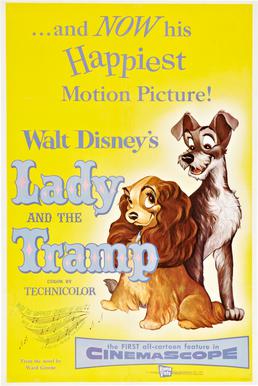
1955
Directed by Hamilton Luske, Clyde Geronimi, and Wilfred Jackson
Welcome back to Movie Monday, dear readers! Since this is the first Monday of the month, we’re taking a well-deserved break from my ongoing series about the absolute worst movies I’ve ever had the misfortune to witness. Consider this your monthly palate cleanser—a chance to remember that cinema can actually be beautiful, meaningful, and not make you question your life choices. Today, we’re diving into one of Disney’s most enduring animated classics: Lady and the Tramp.
Released seventy years ago on June 22, 1955, this film holds a special place in my heart—and apparently in the hearts of countless others, considering it was selected for preservation in the National Film Registry in 2023 as being “culturally, historically or aesthetically significant.” Not bad for a movie that critics initially dismissed as overly sentimental dreck.
When Dogs Could Talk (And We Actually Listened)
Lady and the Tramp tells the story of a pampered American Cocker Spaniel whose comfortable world gets turned upside down when her owners—whom she adorably calls “Jim Dear” and “Darling”—welcome a new baby into their home. Enter the Tramp, a streetwise mutt with a talent for dodging dog catchers and a philosophy of living “footloose and collar free.” It’s the classic tale of opposites attracting, except with four legs and significantly more tail wagging.
What strikes me most about this film, even decades later, is how genuinely it captures the emotional reality of being displaced by change. As someone who grew up with dogs, I can attest to their almost supernatural ability to sense shifts in household dynamics. Speaking of which, I have to share a childhood memory that perfectly illustrates this: when I was a kid, we had a couple of dogs that would interact with this movie more than anything else we put on the television. At the beginning, when Lady is a puppy crying about being left alone in the kitchen at night, our dogs would start howling and whining with her, as if they were begging for Jim Dear or Darling to come and let her out. It was both heartbreaking and hilarious—these dogs were emotionally invested in Lady’s journey in a way that puts most human film critics to shame.
The Art of Animation Innovation
From a technical standpoint, Lady and the Tramp broke significant ground as Disney’s first animated feature filmed in CinemaScope. This wasn’t just a gimmick—it fundamentally changed how the animators approached their craft. The wider canvas created new challenges: characters couldn’t dominate the screen as easily, groups had to be spread out to avoid visual sparseness, and longer takes became necessary to prevent the constant jump-cutting from feeling chaotic.
The animators rose to the occasion brilliantly, particularly in maintaining what they called a “dog’s eye view” throughout the film. Background artists actually built scale models of Jim Dear and Darling’s house and photographed them from deliberately low angles to simulate how a dog would see their world. It’s this attention to detail that makes the film feel so authentic—we’re not just watching dogs, we’re experiencing the world through their eyes.
Perhaps the most famous example of the animators’ dedication is the iconic spaghetti scene. Walt Disney originally wanted to cut it entirely, thinking dogs eating spaghetti would look ridiculous and fail to be romantic. Animator Frank Thomas disagreed so strongly that he animated the entire sequence himself, without official approval. The result? One of the most recognizable romantic scenes in cinema history. It’s even inspired its own slang—to “Lady and the Tramp it” means sharing food from opposite ends until you meet in the middle.
The Magic Behind the Music
The film’s musical contributions came largely from Peggy Lee, who not only provided voices for four different characters but also co-wrote six songs for the film. This was arguably the first instance of a major celebrity being cast for their star power in an animated film—a practice that would eventually become the industry standard. Lee voiced Darling, the sultry Peg at the dog pound, and the mischievous Siamese cats Si and Am.
Her work on “He’s a Tramp,” “La La Lu,” and “The Siamese Cat Song” helped establish the film’s musical identity. Interestingly, the only song in the film she didn’t write was “Home Sweet Home,” performed by The Mellomen during the pound scene. Lee’s involvement would later lead to a groundbreaking legal battle when she sued Disney for royalties on video sales, ultimately winning $2.3 million in 1991—a victory that helped establish important precedents for artist compensation in the home video era.
The Complicated Legacy We Can’t Ignore
Now, let’s address the giant Siamese cat in the room. While Lady and the Tramp excels in many areas, it’s impossible to discuss the film honestly without acknowledging its problematic elements. The portrayal of Si and Am, the Siamese cats, relies heavily on racist Asian stereotypes—from their exaggerated eye shape and buck teeth to their broken English and sneaky, destructive behavior. The pound scene features similarly stereotypical characters like Pedro the Mexican Chihuahua and Boris the Russian Borzoi, all speaking in heavily accented, caricatured voices.
These elements were wrong in 1955, and they’re wrong now. Disney has since added content warnings to the film on Disney+, noting that it “includes negative depictions and/or mistreatment of people or cultures.” It’s a necessary acknowledgment, though it doesn’t erase the harm these portrayals have caused. The 2019 live-action remake attempted to address this by completely removing “The Siamese Cat Song,” though most critics agreed the replacement was forgettable at best.
This is where we, as modern viewers, have to engage in some critical thinking. We can appreciate the technical achievements, storytelling prowess, and genuine emotional moments in Lady and the Tramp while simultaneously recognizing and rejecting its harmful stereotypes. It’s not about canceling the past—it’s about learning from it and doing better in the future.
A Production Born from Perseverance
The journey to bring Lady and the Tramp to the screen was remarkably long and complicated. In 1937, story artist Joe Grant approached Walt Disney with sketches inspired by his own English Springer Spaniel, also named Lady, who had been “shoved aside” when Grant’s family welcomed a new baby. Disney loved the concept and commissioned story development, but nothing quite clicked for nearly six years.
The breakthrough came when Disney read Ward Greene’s short story “Happy Dan, the Cynical Dog” in Cosmopolitan magazine in 1943. He bought the rights and had Greene’s cynical dog character adapted into what would become the Tramp. The character went through several name changes—Homer, Rags, and Bozo—before settling on his final moniker. Interestingly, Grant, who originated the concept, left the studio in 1949 and didn’t receive proper credit for his contributions until the 2006 Platinum Edition DVD release.
Greene wrote a full novelization of the story at Disney’s insistence, releasing it two years before the film to familiarize audiences with the plot. This unusual marketing strategy paid off—the film became the highest-grossing Disney animated feature since Snow White and the Seven Dwarfs, earning $6.5 million on a $4 million budget.
Technical Marvels and Happy Accidents
Some of the film’s most memorable moments came from creative problem-solving and animator intuition. The beaver character who helps remove Lady’s muzzle was essentially recycled as Gopher in Winnie the Pooh and the Honey Tree, complete with the same whistling speech pattern. Voice actor Stan Freberg found the vocal effect so challenging that the studio eventually resorted to using an actual whistle to achieve the desired sound.
Wolfgang Reitherman, who would later direct several Disney classics, actually kept rats in a cage next to his desk while animating the climactic fight scene between Tramp and the rat. This dedication to understanding animal movement and behavior permeates the entire film—every tail wag, ear perk, and head tilt feels authentic rather than anthropomorphized.
The decision to film in CinemaScope came mid-production, forcing the background artists to extend many paintings to fit the wider format. Often, they used overlays to cover the seams where extensions met original artwork. Despite these challenges, or perhaps because of them, the film maintains a visual cohesion that enhances rather than distracts from the storytelling.
Modern Reception and Lasting Impact
Contemporary critics were notably harsh on Lady and the Tramp. Bosley Crowther of The New York Times complained about the “thickness of the goo” and felt the CinemaScope format magnified the animation’s flaws. Time magazine suggested that Disney’s usual combination of “gooey sentiment and stark horror” simply didn’t work this time around.
How wrong they were. The film now holds a 93% approval rating on Rotten Tomatoes, with critics praising it as “a nostalgic charmer” whose “songs and richly colored animation are technically superb and make for a memorable experience.” Gene Siskel and Roger Ebert both gave it positive reviews during its 1986 re-release, with Ebert particularly praising the opening puppy scenes as among Disney’s greatest animated sequences.
The American Film Institute has recognized the film multiple times, ranking it #95 on their “100 Greatest Love Stories” list—one of only two animated films to make the cut, alongside Beauty and the Beast. The iconic spaghetti scene has become so culturally embedded that it’s referenced constantly in other media, parodied endlessly, and remains the go-to visual shorthand for romantic dining.
The Remake Question (Brief and Brutal)
I’d be remiss not to mention the 2019 live-action remake, though frankly, I’d rather not. Released directly to Disney+ with voices by Tessa Thompson and Justin Theroux, it exemplifies everything wrong with Disney’s current remake obsession. Critics noted that while “Lady and the Tramp’s cute dogs and likable cast work well enough, the live-action update lacks some of the magic that made the original 1955 film such a delight.” The CGI was unconvincing, the charm was artificial, and the whole enterprise felt like checking a box on someone’s corporate to-do list rather than genuine artistic expression.
But let’s not dwell on that disappointment when we have the original masterpiece to celebrate.
Why It Still Matters
At its core, Lady and the Tramp works because it understands something fundamental about love and belonging. Lady’s journey from sheltered privilege to street-smart independence mirrors many of our own experiences with unexpected change. The film asks important questions: What happens when your comfortable world shifts? How do you maintain your identity while adapting to new circumstances? Can love really bridge different backgrounds and experiences?
These themes resonate as strongly today as they did in 1955. The film’s portrayal of family dynamics—both human and canine—feels genuine because it’s rooted in universal emotions rather than Disney’s sometimes-cloying sentiment. When Lady discovers she can love both her human family and her new canine family, it’s a lesson about expanding hearts rather than choosing sides.
The technical innovations, particularly the CinemaScope cinematography and the authentic animal animation, established standards that continue to influence animated filmmaking today. More importantly, the film’s success proved that original stories could compete with adaptations of beloved classics—a lesson Disney seems to have forgotten in their recent remake frenzy.
A Final Toast to Timeless Romance
Lady and the Tramp represents Disney animation at a fascinating crossroads—technically ambitious enough to experiment with new formats and storytelling techniques, yet intimate enough to focus on genuine character development and emotional truth. It’s a film that trusts its audience to invest in the relationship between two dogs without needing constant action or broad comedy to maintain interest.
Yes, we must acknowledge and reject its stereotypical portrayals. Yes, we should demand better representation in modern animated films. But we can also appreciate what Lady and the Tramp does well: its gorgeous animation, memorable music, innovative cinematography, and most importantly, its sweet, sincere heart.
In an era of cynical reboots and corporate-mandated content, there’s something refreshing about returning to a film that genuinely believes in the power of love, the importance of family (however you define it), and the magic that can happen when two very different souls find each other over a plate of spaghetti.
Now if you’ll excuse me, I need to go watch this with my own dogs and see if they still howl along with Lady’s midnight lament. Some things, thankfully, never change.
Next Monday, we’ll return to our regularly scheduled programming of cinematic disasters. Until then, may your spaghetti always lead to romance, and may your dogs always find their way home.
 The Confusing Middle
I’ve never had a dog, but I’ve loved Lady and the Tramp since I was a young pup. Genuinely heartfelt and memorable. You’re right that there doesn’t need to be constant action or comedy to hold interest. I still sing the songs from time to time.
LikeLiked by 1 person