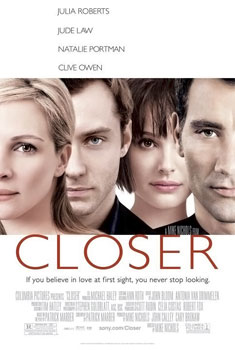
2004
Directed by Mike Nichols
Welcome back to Movie Monday, where we continue our painful journey through the worst films I’ve ever had the misfortune to sit through. Today we’re landing at number 55 on my personal list of cinematic nightmares: Mike Nichols’ 2004 “romantic” drama Closer. Now, before you sharpen your pitchforks and light your torches, remember this list is purely my opinion. What I consider an exercise in pretentious torture might be your favorite exploration of human relationships. But stick around, because I’m about to explain exactly why this film made me want to throw things at my TV.
Closer sits comfortably between House of 1000 Corpses (#56) and Look Who’s Talking Now (#54) on my list, and honestly, that’s fitting company. At least Rob Zombie’s gore-fest knows what it is, and the talking dog movie doesn’t pretend to be high art. Closer, on the other hand, struts around like it’s delivering profound insights into the human condition when it’s really just serving up 104 minutes of beautiful people being absolutely horrible to each other.
The Setup: Four People You Wouldn’t Want to Share an Elevator With
The film follows four attractive, articulate adults in London as they lie, cheat, manipulate, and emotionally brutalize each other in the name of love. We have Dan (Jude Law), a writer who’s basically a nice guy™ with the emotional maturity of a turnip; Alice/Jane (Natalie Portman), a stripper/waif who lies about her name for the entire film; Anna (Julia Roberts), a photographer who seems to exist in a perpetual state of emotional constipation; and Larry (Clive Owen), a dermatologist who treats every conversation like a bar fight waiting to happen.
Based on Patrick Marber’s award-winning play, Closer was clearly designed to be a scathing examination of modern relationships. The problem is that it’s so busy being scathing that it forgets to give us any reason to care about these people. It’s like watching four sociopaths play emotional chess, except the game never ends and nobody wins.
The Theatrical Problem: When Stage Doesn’t Translate to Screen
Let’s start with the most obvious issue: this is a filmed play that never quite becomes a movie. The dialogue is razor-sharp, sure, but it’s sharp in that artificial, “written to be quoted on someone’s Instagram story” way. Characters don’t talk to each other; they deliver monologues at each other. Every conversation feels like a verbal duel where everyone’s trying to land the most devastating one-liner.
The film contains approximately 510 questions between the characters—that’s about 5 questions per minute of runtime. Think about that. When was the last time you had a conversation that was basically just people interrogating each other for two hours straight? It’s exhausting, and not in a good way.
Take this exchange between Larry and Alice in the strip club: “What’s your name?” “Jane.” “Your real name.” “Jane Jones.” “Liar. What does your boyfriend call you?” “Alice.” “Alice what?” “Just Alice.” “Alice who?” “Alice Ayres.” “Is that your real name?” “Yes.”
It goes on like this. For the entire film. Everyone speaks in these clipped, performative declarations that sound like they’re auditioning for a Tennessee Williams play. Which, to be fair, they basically are.
The Characters: A Masterclass in Insufferable
Dan (Jude Law): The Toxic Nice Guy
Dan is perhaps the most infuriating character in a film full of infuriating characters. He’s written as the sensitive writer type—the guy who’s supposed to be our entry point into this world of beautiful, damaged people. Instead, he’s a manipulative, hypocritical narcissist who spends the entire film playing the victim while systematically destroying everyone around him.
Law plays him with this soft-spoken smugness that makes every scene feel like emotional waterboarding. Dan cheats on Alice with Anna, confesses the affair, then demands to know if Alice slept with Larry—as if he has any right to the moral high ground. When she finally admits she did, he completely falls apart, despite literally pushing her to tell him. It’s like watching someone punch themselves in the face and then blame the mirror.
Larry (Clive Owen): The Human Megaphone
If Dan is quietly toxic, Larry is loudly insufferable. Owen plays him like he’s auditioning for a one-man show about toxic masculinity, chewing through every line with such theatrical intensity that you start to wonder if he’s being paid by the decibel. His famous line—”Because I’m a f—ing caveman!”—is delivered with such angry conviction that it becomes unintentionally hilarious.
Owen won a Golden Globe for this performance, which tells you everything you need to know about awards season. Sure, he’s acting his heart out, but he’s acting in service of a character so aggressively unpleasant that watching him feels like punishment. Every scene with Larry is a bar fight waiting to happen, even when he’s just sitting down to sign divorce papers.
Anna (Julia Roberts): The Emotional Void
Roberts, normally warm and charismatic, seems to have had her personality surgically removed for this role. Anna is supposed to be the object of desire that drives the plot, but Roberts plays her with such cold detachment that you start to wonder if she’s actually awake. She drifts through the film like she’s heavily sedated, making choices that seem arbitrary rather than emotionally driven.
Whether this is intentional—Anna as an unknowable cipher—or just bad casting is hard to say. What’s clear is that Roberts brings nothing to bridge the gap between what’s written on the page and what we see on screen. Anna becomes a beautiful blank slate that the men project their desires onto, but there’s no there there.
Alice/Jane (Natalie Portman): The Least Terrible Person
By process of elimination, Portman’s Alice becomes the most sympathetic character, mainly because she’s the only one who seems to actually feel pain without immediately weaponizing it against someone else. But even she’s saddled with the film’s most contrived plot device—the fact that she’s been lying about her name for four years.
The big revelation that her real name is Jane Jones is supposed to be some profound statement about identity and truth, but it comes across as a cheap trick. It’s like the film wanted to end on a note of mystery rather than meaning, so it just tossed in a twist that undercuts everything we’ve been through with the character.
The Scenes That Make You Want to Throw Things
The Cybersex Chatroom Disaster
If there’s one scene that perfectly encapsulates everything wrong with Closer, it’s the infamous internet sex scene where Dan pretends to be Anna in a chatroom to lure Larry into a sexual conversation. This is supposed to be clever—a commentary on deception and identity in the digital age. Instead, it plays like a comedy sketch that wandered into the wrong movie.
The entire premise is juvenile and implausible. The execution is awkward and dated. And the fact that this ridiculous setup triggers a major plot turn—Dan essentially sends Larry to meet Anna, kickstarting their affair—makes it even more absurd. It’s like watching someone try to Rube Goldberg their way into a love triangle.
The Apartment Interrogation
The scene where Dan demands that Alice tell him whether she slept with Larry is a masterclass in emotional abuse disguised as powerful drama. Dan, who has just confessed to cheating, badgers his girlfriend into admitting her own infidelity, then completely crumbles when she does. It’s toxic masculinity wrapped in the pretense of “needing the truth.”
The film presents this as a moment of brutal honesty, but it’s really just cruelty. Dan doesn’t want the truth; he wants to be right. And when Alice gives him what he demands, he punishes her for it. It’s emotional manipulation 101, but the film treats it like profound character development.
The Strip Club “Truth” Session
The extended scene between Alice and Larry in the strip club is uncomfortable for all the wrong reasons. It’s supposed to be raw and honest—two people finally dropping their masks and being real with each other. Instead, it feels like watching someone’s therapy session that you definitely shouldn’t be witnessing.
Portman and Owen both commit fully to the scene, but the writing is so theatrical and the setup so contrived that it never feels authentic. It’s performed honesty rather than actual honesty, which is pretty much the film’s biggest problem in a nutshell.
The Pretension Factor: Style Over Substance
Closer is absolutely gorgeous to look at. The cinematography is sleek, the production design is immaculate, and everyone looks like they stepped out of a high-end fashion magazine. But all that visual polish can’t hide the fact that the film is emotionally barren.
The movie is so busy being sophisticated that it forgets to be human. It’s set in art galleries and upscale restaurants, populated by people with glamorous careers who speak in perfectly crafted sentences about love and truth and desire. But none of it feels real. It’s like watching beautiful mannequins recite philosophy.
The film’s relationship to Mozart’s Così fan tutte is particularly telling. The opera is about couples who test each other’s fidelity through elaborate deceptions, ultimately revealing that everyone is capable of betrayal. It’s a cynical view of love, but one that’s wrapped in beautiful music and elegant staging. Closer attempts the same trick, but without the beauty or elegance that makes the cynicism palatable.
The Message Problem: Nihilism Disguised as Insight
If Closer has a message, it seems to be that everyone lies, everyone cheats, and no one is capable of genuine connection. Love is just mutual delusion, truth is a weapon, and relationships are battlefields where everyone loses. It’s nihilism dressed up as profundity.
The problem isn’t that this worldview is necessarily wrong—plenty of great films have explored the darker side of human relationships. The problem is that Closer doesn’t earn its cynicism. It doesn’t show us characters struggling against their worst impulses or finding moments of genuine connection before losing them. It just presents us with four awful people being awful to each other and expects us to find it meaningful.
Great films about dysfunctional relationships—Who’s Afraid of Virginia Woolf?, Blue Is the Warmest Color, Marriage Story—work because they show us the humanity within the dysfunction. They make us care about the characters even as they destroy each other. Closer just makes us want to leave the theater.
The Critical Disconnect
Despite my feelings about the film, Closer received generally positive reviews and numerous award nominations. It holds a 67% on Rotten Tomatoes and earned Academy Award nominations for both Portman and Owen. Clearly, I’m not the only one who found it problematic, but I’m also not in the majority.
Roger Ebert praised the film’s articulate dialogue, calling it “refreshing in a time when literate and evocative speech has been devalued in movies.” Peter Travers of Rolling Stone called it “haunting” and “hypnotic,” praising the “dynamite performances from four attractive actors doing decidedly unattractive things.”
But other critics saw through the pretense. The New York Times’ A.O. Scott noted that while the film had “the virtue of unpredictability,” it ultimately “collapses into a welter of misplaced intensity.” The Atlantic’s Christopher Orr was even harsher, calling it “flamboyantly bad” and “a potty-mouthed fantasy that somehow mistakes itself for a fearless excavation of the dark recesses of the human soul.”
The Lasting Impact: When Awards Don’t Matter
Closer made money—$115 million worldwide on a $27 million budget—and won awards. But has anyone watched it recently? Has anyone quoted it approvingly or recommended it to friends? The film’s cultural footprint is virtually nonexistent, which tells you everything you need to know about its lasting impact.
The most memorable thing about Closer might be the trivia: Natalie Portman gave Julia Roberts a necklace that said “cunt” to celebrate their characters’ foul mouths. Roberts returned the favor with a necklace that said “lil’ cunt.” It’s a perfect metaphor for the film itself—a gesture that’s supposed to be meaningful and transgressive but just comes across as juvenile and trying too hard.
The Verdict: Beautiful People, Ugly Behavior, Empty Experience
Closer is a film that mistakes cruelty for insight, cynicism for depth, and theatrical dialogue for authentic emotion. It’s beautifully shot, well-acted in a technical sense, and occasionally clever, but it’s ultimately hollow. It’s the kind of film that makes you feel sophisticated for watching it, then leaves you feeling dirty afterward—and not in a good way.
The film’s biggest sin isn’t that it’s bad—plenty of films on this list are objectively worse from a technical standpoint. Its sin is that it’s pretentious. It thinks it’s saying something profound about human nature when it’s really just watching beautiful people be horrible to each other for two hours.
At #55 on my worst films list, Closer sits right where it belongs—not quite bad enough to be memorably awful, but too insufferable to be enjoyed. It’s the kind of film that wins awards and gets good reviews but leaves audiences feeling like they need a shower afterward. And not the good kind of uncomfortable that challenges you and makes you think—the bad kind that just makes you want to watch something with characters you don’t actively hate.
So there you have it, another entry in our journey through cinematic purgatory. Next week, we’ll be climbing slightly higher on the ladder of awfulness to discuss Look Who’s Talking Now, a film that at least has the decency to be honest about how stupid it is.
Until then, remember: just because something is well-crafted doesn’t mean it’s worth your time. Sometimes beautiful people saying ugly things in pretty locations is just… ugly.
 The Confusing Middle
“Hello stranger,” I actually reviewed Closer earlier this year. So I guess I’m one of the few who remember it. You may be surprised to know I had it on my list for awhile before I figured it made the most sense paired up with Anora. I’m not fond of excessive language so that’s probably my biggest complaint. Otherwise I found myself liking Closer. More for the unorthodox plot structure than the characters themselves. I don’t disagree that they are horrible people, but I couldn’t look away. You mentioned Who’s Afraid of Virginia Woolf? I wonder if you knew both movies were directed by Mike Nicols? I viewed it the same way in terms of prolonged arguments between a limited cast of four.
LikeLiked by 1 person