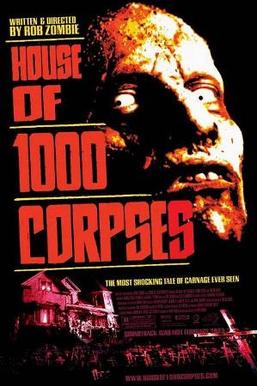
2003
Directed by Rob Zombie
Welcome back to Movie Monday, where we’re systematically working our way down my list of the 100 worst movies I’ve ever seen. Today we’ve arrived at number 56: Rob Zombie’s 2003 directorial debut, House of 1,000 Corpses. Before we dive in, let me remind you that this list is based entirely on my personal opinion, so if this happens to be your favorite film, we can still be friends. Probably.
House of 1,000 Corpses is what happens when someone watches The Texas Chain Saw Massacre and The Hills Have Eyes, then decides, “You know what these films need? More clowns, more nonsensical plot threads, and significantly more scenes that make absolutely no sense.” The result is a film so aggressively weird that when the credits rolled, my college roommate and I looked at each other and simultaneously said, “That movie was effed up.” Not “that was awesome” or “that was terrifying” – just a shared acknowledgment that we’d witnessed something fundamentally broken.
The Plot (Such As It Is)
The story follows four college students writing a book about roadside attractions who stumble upon Captain Spaulding’s gas station/horror museum. Spaulding, played by Sid Haig in full clown makeup, tells them about the local legend of Dr. Satan, a mad doctor who was supposedly hanged from a nearby tree. Because horror movie protagonists have a collective death wish, they immediately decide to hunt down this tree, picking up a hitchhiker named Baby Firefly along the way.
What follows is essentially 89 minutes of the Firefly family – a collection of psychotic hillbillies who make the Manson family look like the Waltons – torturing, killing, and generally terrorizing their victims in increasingly elaborate ways. There’s also an underground lair, failed medical experiments, and a finale that suggests the filmmakers threw darts at a board of horror movie tropes to determine the ending.
The film wants desperately to be a throwback to 1970s grindhouse horror, complete with grainy film stock, jarring editing, and enough gore to stock a small morgue. What it actually achieves is more like watching someone’s fever dream about horror movies while they’re coming off anesthesia.
Rob Zombie: From Musician to… This
Rob Zombie’s transition from White Zombie frontman to filmmaker might have seemed natural given his horror-obsessed aesthetic, but House of 1,000 Corpses suggests he confused “loving horror movies” with “understanding how to make them.” The film originated from a haunted house attraction Zombie designed for Universal Studios, which explains a lot about its structure – it feels less like a coherent narrative and more like a series of themed rooms you’d stumble through while trying not to trip over fog machines.
Universal, showing remarkable prescience, shelved the completed film in 2000 because they feared it would receive an NC-17 rating. The movie spent three years in distribution limbo before Lions Gate finally released it in 2003, and frankly, those might have been the best three years of the film’s existence. Sometimes the anticipation is better than the reality.
Zombie himself has since acknowledged the film’s problems, calling it “a calamitous mess” and admitting “All I see is flaw, upon flaw, upon flaw… upon flaw.” When the director disowns his own work, that’s usually a red flag. (This wouldn’t be Zombie’s last disappointing effort – his Halloween reboot was equally unimpressive, proving that some directors should stick to their day jobs.)
The Firefly Family: Dysfunction Junction
The film’s saving grace, if you can call it that, lies in its villains. The Firefly family is genuinely unsettling, populated by memorable lunatics who chew scenery with gleeful abandon. Sid Haig’s Captain Spaulding is legitimately creepy, Bill Moseley’s Otis Driftwood is appropriately unhinged, and Sheri Moon Zombie’s Baby Firefly is… well, she’s something.
In a bit of trivia that’s more interesting than the actual movie, the family members are named after Groucho Marx characters: Captain Spaulding from Animal Crackers, Otis B. Driftwood from A Night at the Opera, and Rufus T. Firefly from Duck Soup. It’s a clever touch that suggests Zombie has better taste in classic comedy than he does in constructing horror narratives.
The performances range from committed to completely unhinged, with most of the cast seeming to understand they’re in a cartoon masquerading as a horror film. Karen Black, in particular, brings a manic energy to Mother Firefly that’s both compelling and exhausting to watch.
Production Nightmares and Curious Choices
The film’s troubled production history reads like a cautionary tale about what happens when enthusiasm replaces experience. Shot in just 25 days with a budget somewhere between $3-7 million (even Zombie seems unclear on the exact amount), the movie bears all the hallmarks of rushed filmmaking.
Some of the most bizarre scenes were filmed in Zombie’s own basement after principal photography wrapped, which explains why they feel disconnected from the main narrative. Imagine inviting actors over to your house on weekends to film additional torture scenes – it’s either dedication to your craft or deeply concerning behavior, and I’m not sure which.
The film also suffered from Universal’s refusal to halt their studio tours during filming, leading to multiple ruined takes when trams full of tourists would rumble past the set. There’s something almost poetic about a horror movie being disrupted by actual reality.
Technical Disasters and Stylistic Choices
Zombie’s background in music videos becomes painfully apparent in his approach to editing. The film is stuffed with unnecessary cutaways, random black-and-white footage, and jarring transitions that seem designed to hide the fact that there’s no coherent story being told. It’s like watching someone discover Final Cut Pro for the first time and decide to use every available effect.
The gore, while certainly abundant, lacks the visceral impact of the films Zombie is trying to emulate. Instead of building tension and releasing it through violence, the movie just throws blood at the screen and hopes something sticks. It’s gore without purpose, shock without meaning.
The film’s visual style, while occasionally striking, often feels like a Halloween store exploded in a film school editing bay. Every frame screams “look how edgy and artistic I am” while forgetting to serve the story or characters.
Critical Reception: A Universal Pan
Critics were not kind to House of 1,000 Corpses, and for good reason. The film currently holds a 21% rating on Rotten Tomatoes, with most reviews noting its derivative nature and lack of coherent storytelling. The New York Times criticized Zombie’s “encyclopedic approach to the genre” that results in “a crowded, frenzied film in which no single idea is developed to a satisfying payoff.”
The Hollywood Reporter called it “cheesy and ultragory” while being “strangely devoid of thrills, shocks or horror.” When a horror movie fails to be horrifying, that’s a fundamental problem that no amount of blood and screaming can fix.
Even positive reviews were lukewarm at best, with many critics acknowledging the film’s energy while questioning its execution. It’s the kind of movie that makes you appreciate competent filmmaking in other horror films.
The Cult Following Phenomenon
Despite its critical drubbing, House of 1,000 Corpses has developed a devoted cult following over the years. Some viewers connect with its unrestrained weirdness and commitment to being aggressively unpleasant. There’s something to be said for a film that fully commits to its vision, even when that vision is deeply flawed.
The movie spawned two sequels – The Devil’s Rejects (2005) and 3 from Hell (2019) – suggesting that audiences found something worthwhile in Zombie’s particular brand of mayhem. Sometimes a film’s very awfulness becomes part of its charm, like a cinematic guilty pleasure that you’re almost embarrassed to admit watching.
Final Verdict: A Spectacular Mess
House of 1,000 Corpses lands at number 56 on my worst movies list not because it’s incompetently made (though it kind of is), but because it’s so aggressively unpleasant while being fundamentally pointless. It’s a film that mistakes shock for substance and confusion for complexity.
Zombie clearly loves horror movies, but loving something and understanding how to create it are two different skills entirely. The film feels like fan fiction written by someone who’s seen every horror movie ever made but learned all the wrong lessons from them.
If you’re curious about the origins of modern “extreme” horror or want to see what happens when a musician tries to become John Carpenter overnight, House of 1,000 Corpses might be worth a watch. Just don’t expect coherence, subtlety, or anything resembling traditional narrative structure.
The film succeeds in being memorable, which is more than many horror movies can claim. Unfortunately, it’s memorable for all the wrong reasons – like a car accident that you can’t help but stare at as you drive past.
Next week on Movie Monday, we’ll be examining 2004’s “Closer” at number 55. Until then, remember that just because a movie has a cult following doesn’t mean it’s actually good – sometimes it just means people enjoy watching train wrecks together.
 The Confusing Middle
I liked it except for the end was a bit corny.
LikeLiked by 1 person
The only Rob Zombie movies I’ve seen are his Halloween remakes. I’m not sure I can handle anything else he’s directed.
LikeLiked by 1 person