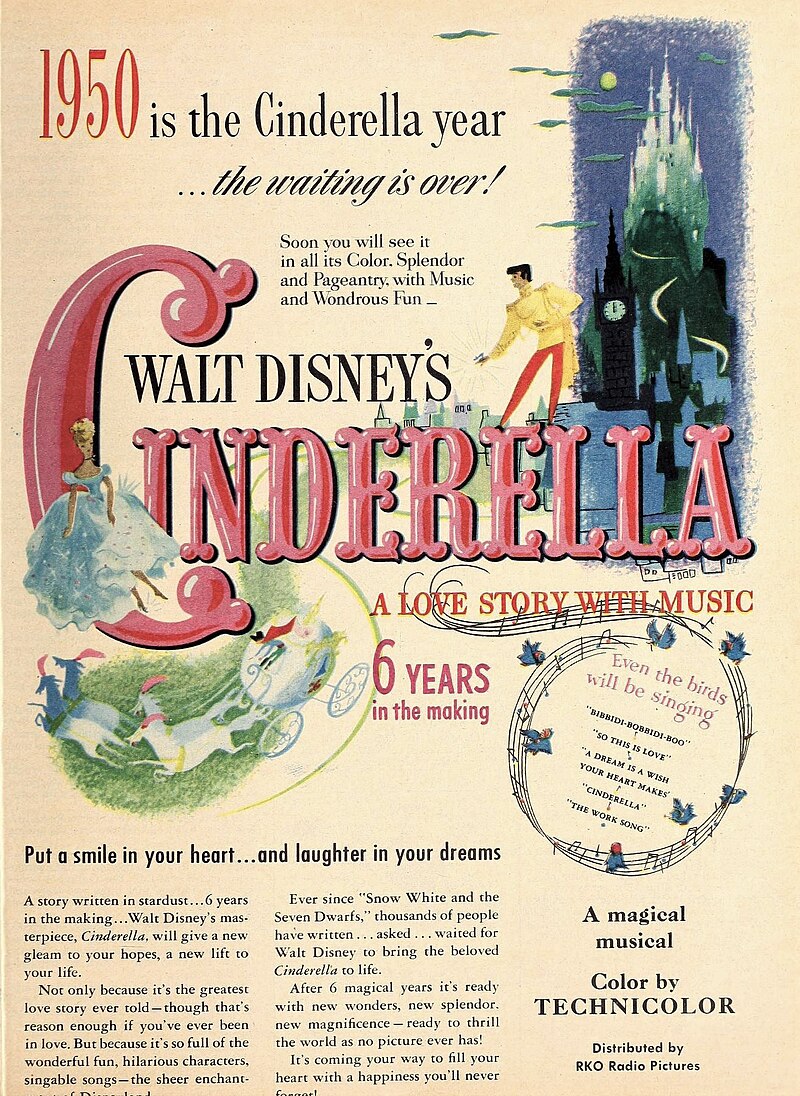
1950
Directed by Wilfred Jackson, Hamilton Luske, & Clyde Geronimi
Welcome back to Movie Monday, folks! Since this is the first Monday of the month, we’re taking our scheduled break from my ongoing series about the worst movies I’ve ever seen. Consider today a palette cleanser as we dive into the world of Disney animation. And boy, do I need it after last week’s cinematic disaster.
Today we’re looking at the 1950 animated classic Cinderella – a film that, if we’re being honest with each other (and when am I not?), I’ve never been the biggest fan of. Don’t get me wrong, I don’t hate it. It’s just not the first one I reach for when I’m in the mood for some Disney magic. But its importance to the House of Mouse can’t be overstated. Without this glass-slippered savior, Disney as we know it might not even exist today.
The “Once Upon a Time” of Disney’s Recovery
By the late 1940s, Walt Disney Productions was in serious financial trouble. After losing European markets during World War II, commercial disappointments like Pinocchio, Fantasia, and Bambi (all of which later became classics) had left the studio more than $4 million in debt – equivalent to about $50 million today. The company was teetering on the edge of bankruptcy.
Roy O. Disney, Walt’s pragmatic older brother, actually suggested selling the studio and retiring with whatever money they could salvage. Can you imagine? No Disney World, no Lion King, no Baby Yoda merchandise overwhelming every Target in America. The horror!
But Walt, ever the dreamer, pushed back. After weeks of arguing, Roy relented, allowing Walt to greenlight one more feature-length animated film. With Cinderella, Alice in Wonderland, and Peter Pan all in development, Walt chose Cinderella because it contained elements similar to their last big hit, Snow White and the Seven Dwarfs.
Smart move, Walt. The film went on to become Disney’s biggest success since Snow White, earning nearly $4.28 million in distributor rentals (the studio’s share of the box office gross) from the United States and Canada alone. It was the fifth highest-grossing film in North America in 1950 and has amassed a lifetime worldwide gross of $182 million across its original release and several reissues. Adjusted for inflation, that’s about $565 million.
From Rags to Riches: The Production
While most of us know the fairytale basics – poor girl, evil stepmother, fairy godmother, glass slipper, happily ever after – the behind-the-scenes story is just as interesting.
This wasn’t actually Disney’s first crack at the Cinderella story. Walt had previously adapted it as a short for the Laugh-O-Gram Studio way back in 1922. But for this feature version, they needed something special.
The film took about two years to complete, with production beginning in earnest around 1948. Unlike previous Disney productions where Walt was heavily involved in day-to-day operations, his participation had noticeably decreased by this time. He was busy with other projects, including his growing obsession with trains and the filming of Treasure Island. The directors often had to mail him scripts, storyboards, and sound recordings while he was in England for over two months in the summer of 1949.
To keep costs down, the animators used an extensive amount of live-action reference footage. Actors were filmed on large soundstages mouthing dialogue, and the footage was then printed frame-by-frame onto large sheets for the animators to use as reference. Actress Helene Stanley served as the live-action model for Cinderella, which must have been… interesting? “Congratulations, you’ve been cast as the lead in a Disney film! No, no one will ever see your face.”
And here’s a fun fact: the fairy godmother’s design was based on Mary Alice O’Connor, the wife of layout artist Ken O’Connor. I’ve always wondered if she got royalties for that.
The Characters: Some More Memorable Than Others
The film’s characters are a mixed bag for me. Cinderella herself is fine – beautiful, kind, and patient to a fault. Perhaps too patient. I mean, at some point, wouldn’t you just snap and “accidentally” spill tea all over Drizella’s fancy dress?
Lady Tremaine, the stepmother, remains one of Disney’s most effectively chilling villains, precisely because she doesn’t have magical powers or transform into a dragon. She’s just purely, realistically mean. Eleanor Audley’s voice performance is perfection – the same intimidating voice she would later bring to Maleficent in Sleeping Beauty.
Then there are the mice. Oh, the mice. I know many people find Jaq, Gus, and their squeaky crew endearing, but they’ve always grated on my nerves a bit. Their baby-talk dialect (“Cinderelly! Cinderelly!”) makes my eye twitch after about five minutes. And let’s be honest – if mice were making clothes in your house, you’d call an exterminator, not thank them.
The Fairy Godmother is delightfully scattered, though she appears for all of about five minutes. And Prince Charming? Well, he’s as bland and forgettable as his name suggests. The man has maybe two lines in the entire film. Talk about a low bar for “charming.”
The Animation: A Return to Form
Whatever my feelings about some of the characters, I can’t deny the artistry on display. After several package films (those compilation features like Fun and Fancy Free that were made to save money), Cinderella marked Disney’s return to the high-quality animation that made Snow White a sensation.
The transformation sequence – where the Fairy Godmother turns the pumpkin into a carriage and Cinderella’s rags into a ballgown – remains a stunning piece of animation magic. Walt Disney himself called it his favorite piece of animation ever created by his studio. Animated by Marc Davis, the scene still holds up beautifully today, with its swirling sparkles and magical color changes.
The backgrounds are lush and detailed, showing the studio at what film critic Jonathan Rosenbaum called “the tail end of [Disney’s] best period, when his backgrounds were still luminous with depth and detail and his incidental characters still had range and bite.”
The Music: Serviceable, Not Spectacular
The soundtrack is… fine. Unlike later Disney films where I find myself humming the tunes for days afterward, Cinderella’s songs have never really stuck with me. “A Dream Is a Wish Your Heart Makes” is pleasant enough, and “Bibbidi-Bobbidi-Boo” earned an Oscar nomination for Best Original Song (it lost to “Mona Lisa” from Captain Carey, U.S.A. – anyone remember that one? Me neither).
Interestingly, Cinderella marked the launch of the Walt Disney Music Company and was a first in using multi-tracks for vocals. For “Oh, Sing Sweet Nightingale,” Ilene Woods recorded second and third vocal tracks to harmonize with herself – a neat technical achievement for 1950.
The album was a huge commercial success, selling about 750,000 copies during its first release and hitting number one on the Billboard pop charts. So clearly, people liked these songs more than I do. Maybe I’m the problem? Nah, couldn’t be.
The Legacy: From Glass Slippers to Castle Spires
Whether I’m personally enchanted by it or not, Cinderella’s cultural impact is undeniable. The success of the film gave Disney the cash flow to finance a slate of new productions, establish his own distribution company, enter television production, and begin building Disneyland. Without Cinderella, there would be no Disney theme parks as we know them today – the iconic Cinderella Castle serves as the centerpiece of Walt Disney World’s Magic Kingdom.
The film was selected for preservation in the United States National Film Registry by the Library of Congress in 2018 as being “culturally, historically, or aesthetically significant.” Not bad for a story about a girl with inexplicably tiny feet and questionable taste in footwear material. (Glass? For dancing? That’s just asking for blisters… or worse.)
The American Film Institute ranked Cinderella as the ninth best animated film of all time, writing: “one of the most recognizable fairytale stories ever, Cinderella has stood the test of time.” Hard to argue with that.
The film has spawned two direct-to-video sequels (of varying quality), numerous merchandise lines, appearances in the Kingdom Hearts video games, and a 2015 live-action adaptation starring Lily James and directed by Kenneth Branagh.
Final Thoughts: A Different Kind of Magic
As I mentioned at the start, Cinderella isn’t my go-to Disney film. I find its pacing a bit slow at times, and the focus on the mice and their cat-and-mouse antics takes screen time away from developing Cinderella herself.
But I’ve come to appreciate it more as I’ve learned about its historical significance. This film literally saved Disney from potential ruin and set the stage for everything that came after. Without Cinderella’s success, we might never have gotten The Little Mermaid, Beauty and the Beast, or The Lion King – films that defined many of our childhoods.
It’s also worth noting that Cinderella represents a pivotal moment in animation history. The techniques developed and refined during its production influenced generations of animators and filmmakers.
Is it perfect? No. But its impact on animation, the Disney company, and pop culture as a whole is immeasurable. As TCM host Ben Mankiewicz put it, “Disney was on the ropes. Cinderella saved Disney.”
So if you’re feeling nostalgic or want to see the film that rescued the Mouse House, Cinderella is available to stream on Disney+. Just try not to get too annoyed when the mice start singing. Or do what I do and use that time to refill your popcorn bowl.
Next week, we’ll return to our regularly scheduled programming of cinematic disasters. Until then, remember: dreams do come true… especially if you have a fairy godmother and are willing to run around in impractical footwear.
What’s your take on Cinderella? Love it? Hate it? Indifferent? Let me know in the comments below!
 The Confusing Middle
I absolutely adore Cinderella! I typically avoided movies or shows made for girls when I was a kid, but Disney was always the exception. Cinderella is a classic that I’ve seen many times since I was young. The Fairy Godmother dress transformation is rightfully one of the best animation shots in Disney history. The mice may take up a lot of screen time, but I’ve always loved them. The same goes for the songs that all managed to stick with me (and yes, that includes “Cinderelly”). She doesn’t throw a single punch, but Lady Tremaine might be the Disney villain I hate the most. Something about physiological manipulation always gets under my skin. Cinderella herself deserves much more credit as an earlier Disney princess. She may appear passive, but she doesn’t give up on her dreams, and I always found that admirable.
LikeLiked by 1 person