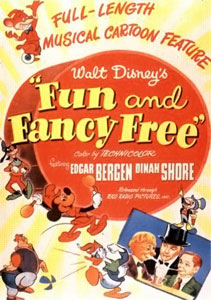
1947
Directed by Jack Kinney
Welcome back, film fans, to another Movie Monday! Since this is the first Monday of the month, we’re taking a brief vacation from our ongoing exploration of cinema’s greatest disasters to cleanse our cinematic palates with some classic Disney animation. And boy, do we need it after last week’s disaster. (Note to self: never watch Mouse Hunt and Jaws: The Revenge in the same week.)
Today we’re diving into 1947’s Fun and Fancy Free, a film that perfectly encapsulates both the magic and the mayhem of Disney’s “package film” era. If you’re wondering what a package film is, imagine watching two completely different short stories connected by Jiminy Cricket and a ventriloquist dummy. You know, just like nature intended.
The Package Deal
First, some context: During and after World War II, Disney found itself in a bit of a pickle. With international markets cut off and resources scarce, Uncle Walt couldn’t afford to produce the lavish single-narrative features we associate with classic Disney. The solution? Package films – basically the movie equivalent of buying in bulk at Costco. Take a couple of shorter stories that weren’t quite feature-length, throw in some live-action connective tissue, and voilà! You’ve got yourself a movie.
Fun and Fancy Free combines two such stories: “Bongo,” about a circus bear finding love in the wild, and “Mickey and the Beanstalk,” which is… well, exactly what it sounds like. These stories were originally planned as separate features, but as the old saying goes, “When life gives you financial constraints, make a compilation film.”
Bongo: Where Love Hurts (Literally)
The first segment, “Bongo,” tells the story of a circus bear who escapes to the wild and finds love, all narrated by singer Dinah Shore. It’s your classic tale of boy-bear-meets-girl-bear, boy-bear-doesn’t-understand-that-slapping-means-love-in-bear-culture, boy-bear-almost-loses-girl-bear-to-massive-bully-bear. You know, that old chestnut.
Let’s talk about that slapping thing for a moment. In what must be one of Disney’s more questionable romantic messages, the film presents the idea that bears show their love by slapping each other. This leads to a whole musical number called “Say It with a Slap,” which I’m pretty sure didn’t make it into any Valentine’s Day cards. The sequence culminates in what can only be described as a bear mosh pit of violence-as-affection, proving that even Disney sometimes got things spectacularly wrong.
Mickey and the Beanstalk: A Mouse, a Duck, and a Goofy Walk into a Giant’s Castle
The second half of the film gives us Disney’s take on “Jack and the Beanstalk,” with Mickey Mouse in the Jack role and Donald Duck and Goofy along for the ride. This segment is notable for being the last time Walt Disney himself would regularly voice Mickey Mouse – apparently, decades of smoking had made it increasingly difficult for him to achieve Mickey’s signature falsetto. It’s also worth noting that this was one of the few times Mickey, Donald, and Goofy appeared together in a feature film, making it something of a Disney Animation all-star game.
The story is narrated by ventriloquist Edgar Bergen and his dummies Charlie McCarthy and Mortimer Snerd, which might seem like an odd choice for an animated film until you remember that this was 1947, and ventriloquist acts were apparently all the rage. It’s like if modern Disney decided to have a TikTok influencer narrate Frozen 3.
The segment itself is actually quite charming, featuring Willie the Giant, one of Disney’s more memorable antagonists. Willie can change shape, turn invisible, and fly, but he’s also surprisingly lovable for a guy who wants to turn Mickey into a sandwich. His rendition of “Fee-Fi-Fo-Fum” is delightfully goofy (lowercase ‘g’), and his transformation scenes showcase some of Disney’s best animation of the era.
The Historical Impact
Fun and Fancy Free represents a fascinating transition period in Disney’s history. It bridges the gap between the studio’s early classics and its post-war renaissance, showing both the constraints and the creativity of the era. The package film format, while born of necessity, allowed Disney to experiment with different styles and stories while keeping the lights on.
The film also marks several significant milestones. Beyond being Walt’s last regular outing as Mickey’s voice, it represents one of the last times Mickey Mouse would play a starring role in a theatrical release. It’s a bittersweet reminder that even Disney’s biggest star wasn’t immune to changing tastes – by this time, Mickey had already been overshadowed in popularity by Donald Duck and other characters.
The Technical Achievement
Despite the financial constraints of the era, the animation in Fun and Fancy Free is often stunning. The character animation, particularly in “Mickey and the Beanstalk,” showcases the studio’s ability to convey personality through movement. Watch Donald Duck’s descent into hunger-induced madness as he attempts to slice paper-thin portions of a single bean – it’s a master class in character animation.
The backgrounds in both segments are gorgeous, particularly in “Bongo,” where the forest scenes have that classic Disney pastoral beauty. The effects animation in “Mickey and the Beanstalk,” especially during the growing sequence and Willie’s transformations, demonstrates why Disney was still the industry leader in animation quality.
The Legacy
While Fun and Fancy Free may not rank among Disney’s most celebrated films, its influence can be seen in unexpected places. The “Mickey and the Beanstalk” segment, in particular, has enjoyed a long life beyond the original film, airing separately on television with different narrators (including Ludwig Von Drake, which some might argue is an improvement over the ventriloquist act).
The film’s structure, while born of financial necessity, inadvertently predicted the modern anthology format that’s become popular in streaming media. It’s like Disney accidentally invented the Black Mirror format, just with more singing bears and fewer dystopian warnings about technology.
Final Thoughts
Fun and Fancy Free is exactly what its title suggests – a light, entertaining piece of animation history that’s both fun and fancy-free, if not always free of peculiarities. Its flaws (bear-slapping romance, anyone?) are balanced by genuine charm, technical excellence, and historical significance.
Is it Disney’s greatest achievement? No. But as a window into a unique period in animation history, and as a showcase for some genuinely entertaining sequences, it more than earns its place in the Disney canon. Plus, after weeks of reviewing films that make you question your life choices, it’s refreshing to watch something that, while imperfect, was crafted with genuine artistry and care.
Next week, we’ll return to our regularly scheduled programming of cinematic disasters, but for now, let’s appreciate this quirky little piece of Disney history. After all, any film that features Donald Duck trying to eat his own shoe while having a hunger-induced hallucination can’t be all bad.



Fun and Fancy Free is an oddity for sure. The fact that it only has 2 segments isn’t as strange as them being connected through Jiminy Cricket and a ventriloquist. As for my childhood memories, I distinctly remember “Mickey and the Beanstalk” more than “Bongo.” The second segment being significantly more fun in comparison.
LikeLiked by 1 person