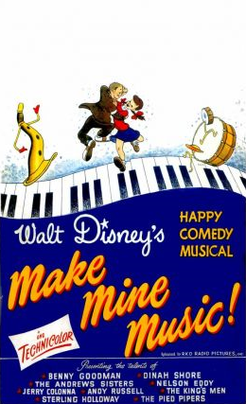
1946
Directed by Jack Kinney
Welcome back, cinephiles, to another Movie Monday! Since it’s the first Monday of the month, we’re taking a breather from our usual parade of cinematic disasters to focus on a bit of Disney magic. Consider it a palette cleanser for your eyeballs. Today, we’re diving into the 1946 animated anthology film, Make Mine Music. So sit back, relax, and let’s explore this often-overlooked gem from Disney’s experimental era.
The War Years: When Mickey Went to Boot Camp
Picture this: It’s the mid-1940s, World War II is raging, and Walt Disney’s studio is in a bit of a pickle. Many of the talented artists who usually bring Mickey and friends to life are off fighting the good fight, leaving the studio with a skeleton crew and a pile of half-baked ideas. What’s a mouse-eared mogul to do?
Enter the “package film” – Disney’s creative solution to keep the lights on and the animation flowing during these lean times. Make Mine Music is the third in this series of anthology films, following Saludos Amigos and The Three Caballeros. Think of it as Disney’s “We’re doing our best with what we’ve got” phase.
A Mixtape of Musical Mayhem
Make Mine Music is essentially the 1940s equivalent of a Spotify playlist on shuffle. It features ten distinct segments, each set to a different style of music. It’s like Disney decided to throw a party and invited classical, jazz, pop, and folk music to duke it out on the dance floor.
Let’s break down this animated mixtape, shall we?
- The Martins and the Coys: A hillbilly hoedown that makes Deliverance look like a relaxing camping trip. This segment was later censored from U.S. video releases because apparently, feuding families with guns were deemed a bit too spicy for home viewing. Who knew?
- Blue Bayou: Originally intended for Fantasia (you know, that other Disney film where classical music meets trippy visuals), this segment features two egrets flying through the Everglades. It’s like a nature documentary, if nature documentaries were scored by dreamy pop ballads.
- All the Cats Join In: Benny Goodman swings while teens jive in this jazzy number. Fun fact: this segment originally featured some mild nudity that was later edited out. Apparently, Disney decided that naked cartoon teens weren’t quite on-brand.
- Without You: A ballad of lost love that’s about as cheerful as you’d expect. Perfect for when you want your animated entertainment with a side of existential crisis.
- Casey at the Bat: Remember this one? It’s the classic tale of an arrogant baseball player whose cockiness leads to his downfall. It’s like The Natural, but with more rhyming and less Robert Redford.
- Two Silhouettes: Ballet dancers pirouette in silhouette because… why not? It’s Disney’s way of saying, “See? We can do high culture too!”
- Peter and the Wolf: Ah, now we’re talking! This Prokofiev classic gets the Disney treatment, with Sterling Holloway (aka the voice of Winnie the Pooh) narrating. It’s like a musical “Scared Straight” program for kids who don’t listen to their grandfathers about wolves.
- After You’ve Gone: Benny Goodman returns, this time with anthropomorphized instruments having a parade. It’s either a delightful romp or a fever dream, depending on your perspective.
- Johnnie Fedora and Alice Bluebonnet: A love story between two hats. Yes, you read that right. It’s Lady and the Tramp, but with headwear. The Andrews Sisters provide the vocals, because if you’re going to have singing hats, you might as well go all out.
- The Whale Who Wanted to Sing at the Met: The grand finale tells the tale of Willie, an operatic whale with dreams of singing at the Metropolitan Opera. Spoiler alert: it doesn’t end well for Willie. It’s like The Little Mermaid meets Moby Dick, with a dash of America’s Got Talent thrown in for good measure.
A Personal Interlude
Now, if you’re like me, you might have fond memories of catching some of these segments on the Disney Channel back in the day. “Casey at the Bat,” “Peter and the Wolf,” “Johnnie Fedora and Alice Bluebonnet,” and “The Whale Who Wanted to Sing at the Met” were often trotted out as standalone shorts, filling those awkward gaps between shows.
Watching these as a kid, I remember being alternately amused, confused, and slightly traumatized. I mean, a whale gets harpooned for having the audacity to dream big? That’s some heavy stuff to process when you’re just trying to enjoy your after-school cartoon fix.
The Sound of Music (and Innovation)
One of the most striking aspects of Make Mine Music is its eclectic soundtrack. This film is like that one friend who insists they “listen to everything” and actually means it. From the folksy twang of “The Martins and the Coys” to the classical strains of “Peter and the Wolf,” and the jazz stylings of Benny Goodman, the film is a veritable jukebox of 1940s musical styles.
The voice talent is equally impressive. We’ve got the Andrews Sisters, Benny Goodman, Dinah Shore, and Nelson Eddy, among others. It’s like Disney raided a 1940s radio station and animated whatever they found.
But it’s not just about the tunes. Make Mine Music also showcases some innovative animation techniques. “Two Silhouettes” uses rotoscoping to create its ballet dancers, a technique where animators trace over live-action footage to create realistic movement. Meanwhile, “All the Cats Join In” features an animator’s pencil actively creating the scene as we watch, breaking the fourth wall in a way that must have seemed mind-blowing at the time.
Reception: A Mixed Bag of Musical Nuts
So, how did audiences and critics respond to Disney’s musical mishmash? Well, it’s complicated.
The film did reasonably well at the box office, grossing over $3 million worldwide. Not too shabby for a film cobbled together from leftover ideas and a depleted workforce.
Critics of the time were generally positive, praising the film’s creativity and variety. Variety called it a “step forward” in animation, while The New York Times gushed over its “brilliant abstraction.” High praise indeed for a film featuring romance between headwear.
However, time hasn’t been entirely kind to Make Mine Music. Modern critics tend to view it as a lesser entry in the Disney canon, lacking the cohesion and artistic heights of Fantasia. It currently holds a lukewarm 58% rating on Rotten Tomatoes, which is basically the equivalent of a participation trophy in the world of film criticism.
The Legacy: A Curious Footnote in Disney History
Make Mine Music occupies a unique place in Disney’s history. It’s not quite forgotten, but it’s not exactly celebrated either. It’s the Disney equivalent of that weird cousin who shows up at family reunions – you know, the one who juggles and plays the accordion simultaneously.
The film’s segmented nature meant that individual shorts could be repurposed for television, which is why many of us have childhood memories of specific segments without ever having seen the full film. It’s like Disney created their own clip show before clip shows were even a thing.
Interestingly, Make Mine Music has had a rocky relationship with home video releases. The film was initially released on home video in Japan in 1985, but it took until 2000 for it to reach American shores. Even then, it came with some edits – “The Martins and the Coys” was entirely removed due to its depiction of gun violence, and “All the Cats Join In” had its mildly risqué content toned down.
As of 2024, Make Mine Music holds the dubious honor of being the only Disney animated film not available on Disney+. It’s like the streaming equivalent of being picked last for dodgeball.
Conclusion: A Flawed but Fascinating Time Capsule
In the end, Make Mine Music is a curious artifact of its time. It’s a glimpse into a Disney studio struggling to keep the magic alive during wartime, a showcase of 1940s popular music, and a testbed for animation techniques that would influence future productions.
Is it Disney’s greatest work? Not by a long shot. But it’s a fascinating window into a transitional period for the studio, and it has its moments of genuine creativity and charm.
So, the next time you’re in the mood for some Disney deep cuts, why not give Make Mine Music a spin? Just don’t blame me if you end up with “The Whale Who Wanted to Sing at the Met” stuck in your head for days. Trust me, it happens.
Until next time, movie lovers. Stay tuned for our regularly scheduled programming of cinematic train wrecks resuming next week. Remember, in the world of bad movies, there’s always plenty of fish in the sea – and some of them might even be operatic whales.
 The Confusing Middle


I’m definitely frustrated that Make Mine Music isn’t on Disney+, but I’m glad it can still be found. I actually remember watching the movie when I was a kid. I distinctly remember Peter and the Wolf and a few other segments. The music is indeed delightful and catchy.
LikeLiked by 1 person