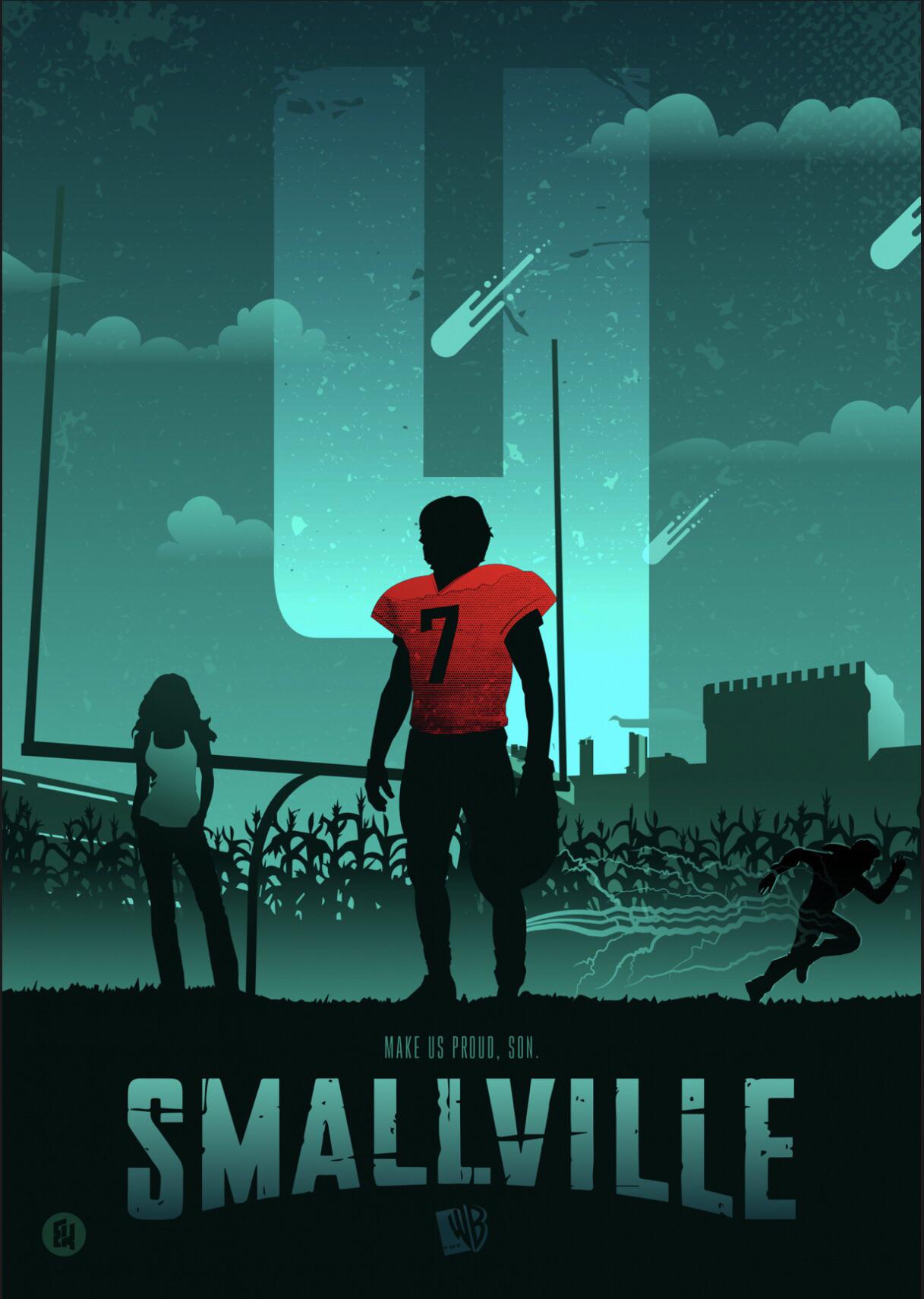
Welcome back to Rewatching Smallville, my weekly dive into the iconic series that explores Clark Kent’s journey before becoming Superman. Whether you’re a long-time fan or new to the show, you’re invited to join in each Tuesday as I revisit episodes and share my thoughts and observations. Be sure to share your own memories and theories in the comments below!
There’s something universally relatable about not wanting high school to end. For some people, those four years represent peak social status, uncomplicated friendships, or a time before adult responsibilities crashed the party. For others, high school was miserable, but even misery has a certain nostalgic glow when viewed through the rearview mirror of time. “Forever” taps into that specific anxiety—the fear that your best days are behind you, that everything after graduation is downhill—and literalizes it through Brendan Nash, a photographer so desperate to preserve the glory days that he builds a fake high school and kidnaps his classmates to live in an eternal senior year. It’s absurd, yes, but this is Smallville, where suspension of disbelief is not just recommended but required. And as the series approaches its own graduation milestone, having a villain who can’t let go of the past feels oddly appropriate.
The Bottle Episode Strategy
Before we dive into petrified teenagers and torture scenes, it’s worth acknowledging the practical context behind “Forever.” According to Tom Welling, this was a cost-saving episode—a strategic move by the producers to stockpile budget for the season finale. It’s a smart play, really. Shows like Smallville live and die by their ability to deliver spectacle in the episodes that matter most, and you can’t go out for summer hiatus with a whimper. You need explosions, special effects, dramatic reveals—the kind of bang that keeps audiences talking until September. So to get there, you occasionally need a bottle episode: contained sets, minimal effects, a story that unfolds mostly in one location with the regular cast.
“Forever” executes this strategy reasonably well. The fake Smallville High is essentially a dressed-up warehouse, and most of the action takes place either there or in familiar standing sets like the Kent farm and the Luthor mansion. It’s not trying to be a visual spectacle. It’s trying to be creepy and claustrophobic, and for the most part, it succeeds. The image of a petrified student frozen mid-motion in a locker room is genuinely unsettling, and the reveal that the windows are just lights behind blinds—that there’s nothing outside this manufactured reality—adds to the sense of dread. Brendan hasn’t just kidnapped people. He’s trapped them in a simulation of normalcy, and that’s arguably more disturbing than a traditional dungeon.
The bottle episode framework also allows the show to focus on character moments without the distraction of large-scale action sequences. Clark and Lana discussing their college plans, Chloe taking down the Wall of Weird, Jonathan and Clark wrestling with the question of destiny versus duty—these are the beats that matter as we approach the end of Season 4, and “Forever” gives them room to breathe. The fact that it does so while also featuring a guy who turns people into wax statues is just Smallville being Smallville.
Brendan Nash and the Petrification Problem
Let’s talk about Brendan Nash, because he’s both the episode’s greatest strength and its most glaring weakness. On paper, he’s a perfect villain-of-the-week for this particular moment in the series. He’s a senior, same as Clark and Lana and Chloe. He’s been voted “Most Likely to Be a Famous Photographer” in the yearbook. He has a clear motivation: he doesn’t want the best years of his life to end, so he’s decided to freeze them in amber—literally. Steven Grayhm plays him with just enough desperation to make him sympathetic without excusing his actions. Brendan isn’t evil in the mustache-twirling sense. He’s pathetic, clinging to a fantasy because the alternative—moving forward into an uncertain future—is too terrifying to face.
The problem, of course, is that his plan makes absolutely no sense if you think about it for more than thirty seconds. He’s built an exact replica of Smallville High inside an abandoned warehouse, complete with fake windows and functioning lockers. How? When? With what resources? And more importantly, what exactly is his endgame here? Is he planning to keep his classmates petrified indefinitely? Does he think they’ll eventually accept this new reality and just… go along with it? The episode handwaves these questions because it has to—dwelling on the logistics would derail the metaphor. But it’s hard not to notice that Brendan’s scheme is less “terrifying plan” and more “elaborate art installation that happens to involve kidnapping.”
Still, the petrification ability itself is effectively creepy. The visual of someone freezing mid-sentence, their skin turning waxy and pale, sells the horror of what Brendan is doing even when the broader plan doesn’t hold up. And the moment where he decapitates Haley—casually pulling her petrified head off like a doll’s—is genuinely shocking. It’s a level of brutality we don’t often see on Smallville, and it raises the stakes considerably. Brendan isn’t just trapping people in nostalgia. He’s willing to kill to protect his fantasy, and that makes him dangerous even if his motivations are more sad than sinister.
Chloe Sullivan: Quick Thinker Under Pressure
One of the episode’s unsung pleasures is watching Chloe navigate the fake high school with a combination of skepticism and resourcefulness. She’s the first to figure out something is wrong, the first to investigate, and the first to start formulating a plan. When another student mentions that she might have a crush on Brendan, Chloe immediately plays along, using Brendan’s need for validation to buy herself and Lana time to escape. It’s a small moment, but it’s quintessentially Chloe—she thinks on her feet, she adapts to the situation, and she’s willing to manipulate emotions if it means survival.
Allison Mack has always been good at playing Chloe’s intelligence without making her seem smug or superior, and “Forever” is a great showcase for that. Chloe isn’t the hero of this episode—that’s still Clark—but she’s the one doing the actual detective work, piecing together the clues and figuring out how to outsmart Brendan. Her partnership with Lana in the escape attempt also works better than you’d expect, given that the two of them have spent much of the season in an awkward triangle with Clark. Here, they’re just two people trying not to die, and that shared goal creates a natural camaraderie that the show doesn’t always give them.
The closing scene, where Chloe takes down the Wall of Weird and shuts down the Torch for the last time, is appropriately melancholic. She’s been the beating heart of Smallville High’s investigative journalism for four years, and now that chapter is over. The show doesn’t linger on this moment—it’s not a big dramatic speech—but the quiet sadness of it lands. Chloe has always been the character most invested in uncovering the truth, and the Wall of Weird has been her greatest project. Taking it down is an acknowledgment that high school is ending, and with it, the innocence of believing that every mystery can be solved if you just dig deep enough.
Clark Kent and the College Question
The Jonathan/Clark subplot about college is functional at best, and that’s being generous. Clark wants to stay close to home and attend Central Kansas University so he can help out on the farm. Jonathan insists that Clark’s destiny lies beyond the cornfields and refuses to let him sacrifice his future out of guilt or obligation. It’s a conflict we’ve seen before, and it doesn’t add much new insight into either character. We know Clark feels responsible for his parents. We know Jonathan wants more for his son than a life of manual labor. And we know that ultimately, Clark is going to stay in Smallville anyway, because the show is called Smallville and not Clark Kent’s Big City Adventure.
Here’s the thing, though: the wheel-spinning is understandable. How else do you continue a show called Smallville once your main character graduates high school? You invent a fictional college within driving distance and hope the audience goes along with it. It worked for Beverly Hills 90210. It worked for Buffy the Vampire Slayer. Why not here? The CKU solution is a narrative convenience, but it’s a necessary one if the show wants to maintain its title and its setting.
That said, I can’t help but think the story would have been more interesting if Smallville had taken a different approach entirely. Imagine if Season 5 had followed Clark on a journey of self-discovery around the world, something closer to Mark Waid’s Superman: Birthright limited series. Let him travel, let him see how other people live, let him grapple with his identity outside the bubble of Smallville. It would have been riskier, sure, but it also would have given the character room to grow in ways that staying in Kansas simply doesn’t allow. Instead, we’re getting CKU, and Clark’s destiny will remain conveniently localized for at least another season.
The conversation between Clark and Jonathan in the barn is well-acted—John Schneider and Tom Welling have an easy chemistry that makes even repetitive material feel sincere—but it doesn’t break new ground. Jonathan’s line about Clark’s destiny lying beyond the cornfields is sweet, and Clark’s response that it’s about the kind of son he wants to be is equally touching. But we’ve had this conversation before, and we’ll have it again. It’s the show running in place, narratively speaking, and while that’s sometimes necessary, it doesn’t make for compelling television.
The Teague Torture Subplot: Brutality and Betrayal
Running parallel to the main story is the Teague family’s increasingly desperate attempt to locate the Kryptonian stones, and it’s as tonally jarring as you’d expect. While Clark and Lana are dealing with a petrified teenager in an abandoned warehouse, Lex and Lionel are being tortured with hot pokers by Genevieve and Jason Teague. It’s the same tonal whiplash we saw in “Ageless,” where intimate character moments rubbed up against high-stakes melodrama, and it doesn’t work any better here. The two storylines exist in entirely different registers, and the episode strains to hold them together.
That said, the Teague subplot does provide some meaty material for the actors. Jane Seymour clearly relishes playing Genevieve as a ruthless pragmatist willing to torture a man she once seduced, and Jensen Ackles brings a manic intensity to Jason that we haven’t seen before. Jason has been a frustratingly passive character for most of Season 4—he’s been manipulated by his mother, lied to by Lana, and generally reduced to standing around looking conflicted. Here, finally, he’s taking action, even if that action is morally indefensible. It’s not enough to redeem the character, but it at least gives him something to do.
Lionel’s manipulation of the situation is peak John Glover. He reveals that Lana is “the Chosen One,” a piece of information that Genevieve and Jason treat as gospel even though Lionel almost certainly made it up on the spot. It’s a classic Lionel move—use just enough truth to make the lie believable, then sit back and watch everyone else scramble. The “Chosen One” line is never explained or elaborated on in future episodes, and some fans consider it a plot hole. But I think it’s simpler than that: Lionel is lying to protect himself and, perhaps inadvertently, to protect Clark. If the Teagues go after Lana, they’re not looking at Clark. It’s misdirection, plain and simple, and it works.
The confrontation between Lex, Lionel, and Jason at the cliff’s edge is where the subplot gets interesting, because it’s one of the few moments in Season 4 where Jason comes close to putting the pieces together. He frantically tells Lex that Clark is “more connected to this than any of us,” referencing the symbols burned into the Kent barn and the mysterious events that keep circling back to the Kent farm. Lex dismisses it as a desperate deflection, but we can see in Michael Rosenbaum’s face that the seed has been planted. Lex doesn’t want to believe that Clark is involved, but Jason’s accusation lingers.
And then Lionel shoots him.
It’s an abrupt, anticlimactic end to Jason Teague, and it feels rushed even by Smallville‘s standards. Jason has been a main character all season, and his death is treated almost as an afterthought—one gunshot, a fall into the river, and he’s gone. There’s no final confrontation with Lana, no moment of redemption or clarity, no real closure. He just… dies. It’s unsatisfying, but maybe that’s the point. Jason was never the hero of his own story. He was a pawn in his mother’s schemes, a complication in Clark and Lana’s relationship, and ultimately, collateral damage in Lionel Luthor’s ongoing chess game.
What’s more significant, I think, is what Jason’s death reveals about Lionel. He didn’t shoot Jason to save Lex, exactly. He shot Jason because Jason was about to expose Clark, whether he knew it or not. Lionel has been positioning himself as Clark’s unlikely protector for a while now, and this moment feels like confirmation. He may be ruthless, manipulative, and morally bankrupt, but he’s also invested in keeping Clark’s secret safe. Whether that’s because he genuinely cares about Clark or because he sees Clark as an asset to be protected for future use is still unclear. Probably both.
The Death of Brendan Nash: Villain Defeats Himself
Clark’s confrontation with Brendan follows the well-worn Smallville formula: villain-of-the-week tries to use their powers on Clark, powers backfire spectacularly, villain dies as a result of their own abilities. It’s a cop-out, narratively speaking, but what else are you supposed to do with one-and-done antagonists? You can’t send them to prison—they’d talk. You can’t have Clark deliberately kill them—that would compromise his character. So you engineer a situation where the villain’s own hubris becomes their downfall, and you hope the audience doesn’t notice that it’s the third or fourth time you’ve used this exact resolution this season alone.
To the episode’s credit, Brendan’s death is at least visually striking. When he grabs Clark in a desperate attempt to petrify him, his powers turn back on himself, slowly turning him to wax. Tom Welling plays Clark’s horror beautifully—he’s not triumphant, he’s devastated. He tries to talk Brendan down, tries to convince him that there’s still time to stop this, but Brendan is too far gone. And when Brendan shatters on impact, it’s a visceral reminder that these powers come with consequences, even for the people who wield them.
The symbolism is a bit on-the-nose: Brendan wanted to freeze time, and he ended up frozen himself, preserved forever in the moment of his greatest desperation. It’s poetic, sure, but it’s also safe. Clark doesn’t have to make a hard choice. He doesn’t have to compromise his morals or wrestle with the ethics of letting someone die. Brendan does it to himself, and Clark walks away with clean hands. It’s efficient storytelling, but it’s also emotionally uncomplicated in a way that feels a little too easy.
Graduation and the Illusion of Closure
The episode wants to give us closure—Chloe dismantling the Wall of Weird, the last issue of the Torch going to print, Clark and Lana and Chloe walking away from the high school together as they prepare for the next chapter. And to some extent, it works. There’s a melancholy to these final moments, a sense that something important is ending even if we know the characters will still be around next season. Chloe’s observation that she can’t think of anything scarier than being stuck in the past and not moving on is the episode’s thesis statement, and it’s delivered with just enough self-awareness to land.
But the weird villain plot does undercut the emotional beats. It’s hard to fully invest in the poignancy of graduation when we’ve just spent forty minutes watching a guy turn people into wax statues and decapitate a cheerleader. The tonal shifts are jarring, and while Smallville has never been a show that worries too much about tonal consistency, “Forever” asks us to pivot from horror to heartfelt farewells a little too quickly.
Still, there’s something fitting about Brendan’s story serving as a cautionary tale for our main characters. Clark, Lana, and Chloe are all standing on the edge of adulthood, looking back at high school with a mix of nostalgia and relief. Brendan’s fate is a reminder that you can’t live in the past, no matter how much you want to. High school ends. Childhood ends. The Torch shuts down, the Wall of Weird comes down, and life moves forward whether you’re ready or not. The episode may not execute that theme perfectly, but it executes it sincerely, and sometimes sincerity is enough.
Does “Forever” Earn Its Goodbye?
“Forever” is a messy episode—part bottle episode, part villain-of-the-week thriller, part meditation on letting go of the past. It doesn’t always succeed at balancing these elements, and the Teague torture subplot feels like it belongs in a different show entirely. But as a penultimate episode before the season finale, it does what it needs to do: it acknowledges that high school is ending, it gives our characters a chance to reflect on what that means, and it sets up the emotional stakes for what’s coming next.
Brendan Nash is a tragic figure, even if his plan doesn’t make a lick of sense. His desperation to hold onto something that’s already gone is painfully human, and the episode doesn’t mock him for it. It just shows us what happens when you let nostalgia become a prison. And in a season that’s been all about stones and secrets and destiny, it’s oddly refreshing to have an episode that’s fundamentally about the fear of growing up.
What are your thoughts on “Forever”? Does Brendan work as a villain, or is his plan too absurd to take seriously? How do you feel about Jason’s abrupt death—satisfying closure or wasted potential? And does the episode earn its emotional farewell to high school, or does the petrification plot get in the way? Share your memories and theories in the comments below!
 The Confusing Middle