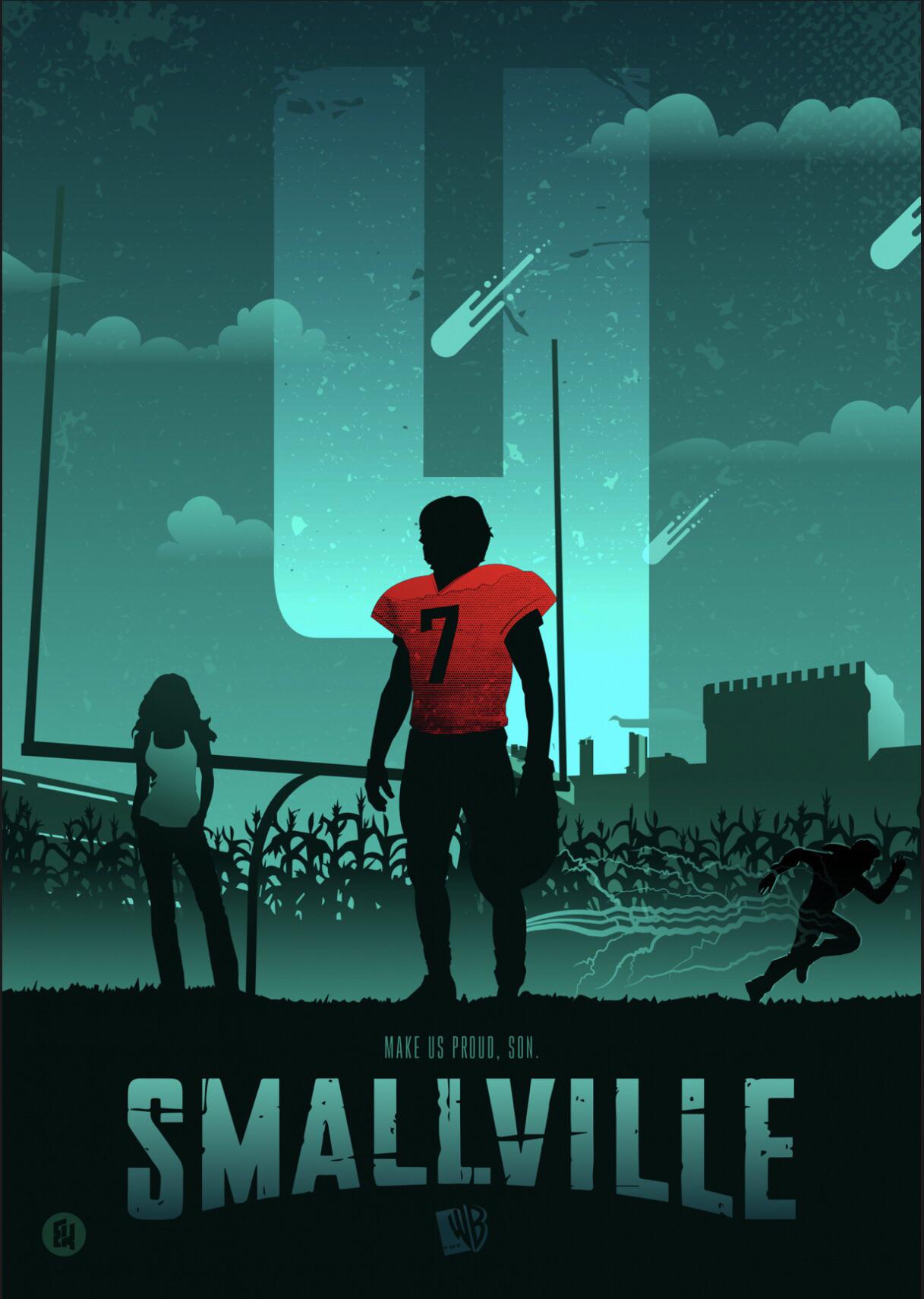
Welcome back to Rewatching Smallville, my weekly dive into the iconic series that explores Clark Kent’s journey before becoming Superman. Whether you’re a long-time fan or new to the show, you’re invited to join in each Tuesday as I revisit episodes and share my thoughts and observations. Be sure to share your own memories and theories in the comments below!
There are television premieres that gently ease you back into a show’s world after a long hiatus, carefully reestablishing characters and relationships with the delicate touch of a master craftsman. Then there’s “Crusade,” the fourth season opener of Smallville, which apparently looked at that approach and said, “You know what? Let’s have our hero immediately go full supervillain, rip the door off a private plane at 20,000 feet, and terrorize Lex Luthor while completely naked under a hospital blanket.”
Twenty years later, it’s clear this was exactly the right choice.
After the nuclear bomb that was season three’s finale “Covenant”—where literally everyone either died, left town, or got their head shaved in prison—Smallville had to rebuild its entire foundation. Rather than tiptoeing around this challenge, “Crusade” embraces it with the subtlety of a meteor shower. The result is an episode that manages to be simultaneously a fresh start and a direct continuation, introducing iconic characters while honoring the show’s mythology, and somehow making Clark Kent’s brief career as an aerial terrorist feel like a natural character progression.
The Art of the Naked Entrance
Let’s address the elephant in the cornfield: Clark Kent has now been naked in six episodes, and we’re only four seasons in. At this point, it’s less a narrative choice and more a series trademark. But “Crusade” uses Clark’s latest disrobed adventure as something more meaningful than fan service—it’s a literal rebirth.
When lightning converges in Miller’s Field (the same field where the toddler Kal-El was found during the 1989 meteor shower, because this show loves its circular storytelling), it creates a pentagonal burn pattern with our hero at the center. For a few brief seconds, the electricity even forms an ‘S’ shape, creating what might be the most expensive superhero logo reveal in television history.
Tom Welling’s performance as the Kal-El personality is genuinely unsettling. This isn’t the red kryptonite version of Clark, who’s basically a college freshman with superpowers and questionable decision-making skills. Kal-El is something far more alien—mechanical, mission-focused, and completely indifferent to human suffering. When he tells Martha that “Clark Kent is dead,” it’s delivered with the emotional warmth of a GPS system announcing your destination.
The split between Clark and Kal-El, achieved through the introduction of Black Kryptonite, gives us one of the series’ most literal visualizations of Clark’s internal struggle. It’s cheesy, sure, but it’s also emotionally effective. When Clark literally stabs his Kryptonian side with a chunk of space rock, it’s hard not to read it as a metaphor for choosing humanity over destiny—even if that metaphor involves a lot more supernatural wrestling than most internal conflicts require.
Enter Lois Lane (And Her Excellent Taste in Men)
The real masterstroke of “Crusade” is the introduction of Erica Durance as Lois Lane. In less than an hour of screen time, the episode establishes everything you need to know about this version of the character: she’s curious, fearless, surprisingly compassionate, and has absolutely zero filter when it comes to uncomfortable situations.
Her first substantial conversation with the amnesiac Clark includes the immortal line: “Not me. Give me a nerd with glasses any day of the week.” The dramatic irony is so thick you could cut it with kryptonite, especially when she’s saying this while staring at Clark Kent, who is literally wrapped in a red blanket that makes him look like he’s already wearing a cape.
Durance brings something special to Lois that previous live-action versions sometimes missed—she’s genuinely funny without being a caricature. When she quips to Clark, “Glad to see we’ve moved beyond the clothing-optional stage of our relationship,” it’s the kind of line that could easily fall flat, but Durance delivers it with perfect timing. The chemistry between her and Welling is immediate and natural, which is impressive considering Welling spends most of their scenes together acting like a malfunctioning android.
The casting of Durance was inspired for reasons beyond just her performance. The show needed someone who could hold her own against Tom Welling’s leading man presence while bringing something fresh to a character that had been defined by previous actresses for decades. IGN would later rank her portrayal above both Margot Kidder and Teri Hatcher, which is the kind of critical acclaim that validates the show’s biggest casting gamble.
The Luthor Family Dysfunction Hour
While Clark is busy having an identity crisis and Lois is establishing herself as the show’s new moral center, the Luthor family is dealing with their own special brand of toxicity. Lex, recovering from being poisoned by his father (because normal family disagreements are for people who don’t own multinational corporations), requires blood purification every 72 hours or his organs will shut down.
This is the kind of hilariously specific medical condition that only exists in superhero television. It’s like the writers said, “We need Lex to be vulnerable but also still capable of flying to Egypt and stealing ancient artifacts. What’s a good middle ground?” The answer, apparently, was making him a part-time dialysis patient with unlimited resources and a complete disregard for FAA regulations.
Michael Rosenbaum sells Lex’s physical vulnerability beautifully, but he also makes sure we understand that Lex’s real weakness isn’t his poisoned blood—it’s his inability to stop obsessing over mysteries he can’t solve. When Kal-El literally rips the door off his plane to steal a Kryptonian crystal, you almost feel bad for Lex. The man just wanted to collect some ancient artifacts in peace, and instead he gets terrorized by a flying farm boy with abandonment issues.
Meanwhile, John Glover’s Lionel continues to be one of television’s great villains, even from a prison cell. His scene with Lois is a masterclass in verbal sparring, with both characters trying to outmaneuver the other through sheer force of personality. When Lois taunts him about potentially being set up, you can see Lionel’s wheels turning—not because he’s worried about the accusation, but because he’s impressed by her audacity.
The Jensen Ackles Factor
The introduction of Jensen Ackles as Jason Teague provides an interesting footnote to the episode’s casting story. Ackles had originally auditioned for Clark Kent himself, losing the role to Tom Welling. His casting as Lana’s new boyfriend feels like the producers saying, “Well, we can’t make you Superman, but how about we make you a mysterious love interest with possible supernatural connections?” See what I did there?
Ackles brings his signature charm to Jason, but there’s something slightly off about the character from his first scene. When he’s explaining to Lana how they met—he clipped her with his Vespa, she kicked him off his bike, and they spent five hours together in the hospital—it sounds romantic in theory. In practice, it sounds like the beginning of a very elaborate con game.
The scene where Lana gets her mysterious tattoo after touching Countess Isobel Thoreaux’s tomb is peak Smallville weirdness. One minute she’s doing a perfectly normal art history assignment, the next she’s got supernatural body art and no memory of how she got home. It’s the kind of plot development that would feel ridiculous in most shows, but Smallville has spent three seasons training its audience to accept that strange things happen to people on a regular basis.
Breaking the Sacred Rule
Perhaps the most significant aspect of “Crusade” is how it handles Clark’s flight. The show’s creators had established a “no tights, no flights” rule, promising that Clark wouldn’t achieve full Superman status until the series finale. “Crusade” technically honors this rule by making it clear that it’s Kal-El who flies, not Clark—but it’s still Clark’s body soaring through the sky.
The flight sequences are surprisingly effective, especially considering this was network television in 2004. When Kal-El hovers outside Lex’s plane, arms at his sides rather than extended forward like the traditional Superman pose, it creates an image that’s both familiar and alien. He’s recognizably the character who will become Superman, but he’s also something else entirely—something potentially more dangerous.
The pilots’ exchange when they spot him—”What is it? A bird? A plane?”—is the kind of meta-commentary that could easily come across as winking at the audience, but instead feels like a natural part of the scene. It’s Smallville acknowledging its place in Superman mythology without being precious about it.
The Martha Kent Emotional Devastation Hour
Annette O’Toole deserves special recognition for her performance in “Crusade.” Martha has to process her son’s personality being completely overwritten, her husband lying comatose in a hospital bed, and the arrival of a young woman asking uncomfortable questions about Clark’s connection to a supposedly dead girl. O’Toole plays it all with a mixture of strength and barely contained panic that feels entirely real.
Her scenes with the Kal-El personality are particularly effective because she’s trying to reach her son through what is essentially a hostile alien entity wearing his face. When she screams for her son to be returned, it’s the kind of raw emotion that reminds you why Smallville works best when it focuses on the human cost of Clark’s extraordinary circumstances.
The introduction of Bridgette Crosby, played by Margot Kidder, adds another layer of Superman film mythology to the proceedings. Kidder’s presence immediately signals to longtime Superman fans that this episode is doing something special with the property’s legacy. When Crosby mentions her past relationship with Dr. Swann “in another lifetime,” it’s a beautiful acknowledgment of Kidder’s history as Lois Lane opposite Christopher Reeve’s Superman.
Industry Context and the Weight of Expectations
“Crusade” premiered on September 22, 2004, to an audience of 4.4 million viewers—a significant drop from earlier seasons but still respectable for the WB. The television landscape was changing rapidly, with shows like Lost and Desperate Housewives redefining what audiences expected from serialized drama. Smallville found itself competing not just for viewers, but for cultural relevance in an increasingly crowded marketplace.
The episode’s mixed critical reception reflects the challenge facing the show. Superman Homepage gave it a perfect 5 out of 5, praising its fresh mythology and character introductions. Fan forums were more divided, with some viewers frustrated by the shift away from the more grounded storytelling of earlier seasons. The criticism wasn’t entirely unfair—”Crusade” does represent a significant tonal shift toward more overt superhero elements—but it misses what makes the episode work.
Rather than abandoning the show’s emotional core, “Crusade” uses its spectacular elements to amplify the human drama. Clark’s flight isn’t just a cool visual effect; it’s a representation of how far he’s drifted from his humanity. Lex’s near-death experience isn’t just plot mechanics; it’s a reminder of how his relationship with his father continues to poison everything in his life.
The Chloe Sullivan Mystery Box
One of the episode’s most effective emotional beats is its handling of Chloe’s apparent death. The show temporarily removed Allison Mack from the opening credits to maintain the illusion that Chloe might actually be gone, which was a bold choice for a series that rarely killed off major characters permanently.
Lois’s investigation into her cousin’s death provides both a compelling mystery and a way to establish her investigative instincts. When she tells Chloe’s grave, “I promise to find out who did this to you, even if I have to do it alone,” it’s the kind of moment that could easily feel manipulative. Instead, it works because Durance plays it with genuine grief rather than melodrama.
The revelation that Chloe’s coffin is empty provides a perfect cliffhanger without feeling cheap. It’s the kind of twist that recontextualizes everything we’ve seen while promising that future episodes will deliver answers rather than just more questions.
Technical Achievement and Visual Storytelling
Director Greg Beeman deserves credit for making “Crusade” feel both intimate and epic. The episode seamlessly transitions between quiet character moments and spectacular action sequences without losing emotional coherence. The lighting in the cave scenes creates an otherworldly atmosphere that makes Jor-El’s influence feel genuinely cosmic, while the hospital scenes maintain the grounded realism that has always been Smallville‘s secret weapon.
The costume design also deserves mention, particularly the way the red blanket serves as a visual echo of Superman’s cape. It’s the kind of subtle detail that works on multiple levels—it’s practical (hospitals give patients blankets), symbolic (connecting Clark to his future identity), and slightly absurd (he’s basically wearing a toga made of medical supplies).
Why “Crusade” Endures
Twenty years later, “Crusade” holds up as both an effective season premiere and a strong standalone episode. It successfully resets the show’s status quo while honoring everything that came before. Most importantly, it understands that Smallville works best when it uses Superman mythology to explore fundamentally human concerns about identity, family, and the weight of expectations.
The episode’s willingness to fully commit to its more outlandish elements—Clark flying, ancient artifacts, mystical possession—actually strengthens its emotional core. When the spectacular serves the character development rather than replacing it, the result is television that works on multiple levels.
“Crusade” also benefits from the show’s accumulated goodwill. By season four, Smallville had earned the right to take bigger swings because it had established its characters so thoroughly. When Clark struggles with his dual identity, or Lex confronts his father’s manipulations, or Martha fights for her family, we’re invested in the outcomes because we’ve watched these relationships develop over time.
The Verdict
“Crusade” succeeds because it understands that the best superhero stories are really just human stories with better special effects. Yes, Clark flies and rips doors off airplanes, but the episode’s real power comes from moments like Martha pleading for her son’s return, or Lois promising to find justice for her cousin, or even Lex trying to make sense of a world that seems designed to drive him insane.
The episode also marks a turning point for Smallville as a series. This is where the show fully embraces its destiny as Superman’s origin story rather than just a teen drama with superpowers. It’s a risky transition that doesn’t always work perfectly, but “Crusade” makes it feel inevitable rather than forced.
If you’re looking for the moment when Smallville transformed from a show about a boy with a secret into a show about a hero discovering his purpose, “Crusade” is that moment. It’s messy, spectacular, emotionally complex, and slightly ridiculous—in other words, it’s everything that made Smallville special.
Just maybe don’t think too hard about the logistics of that airplane scene. Some things are better left to suspension of disbelief and really good stunt coordination.
 The Confusing Middle

The flying scene is iconic, but the Lois Lane introduction is an all time favorite of mine. Erica Durance is easily one of the greatest actresses to ever play the intrepid reporter.
LikeLiked by 1 person