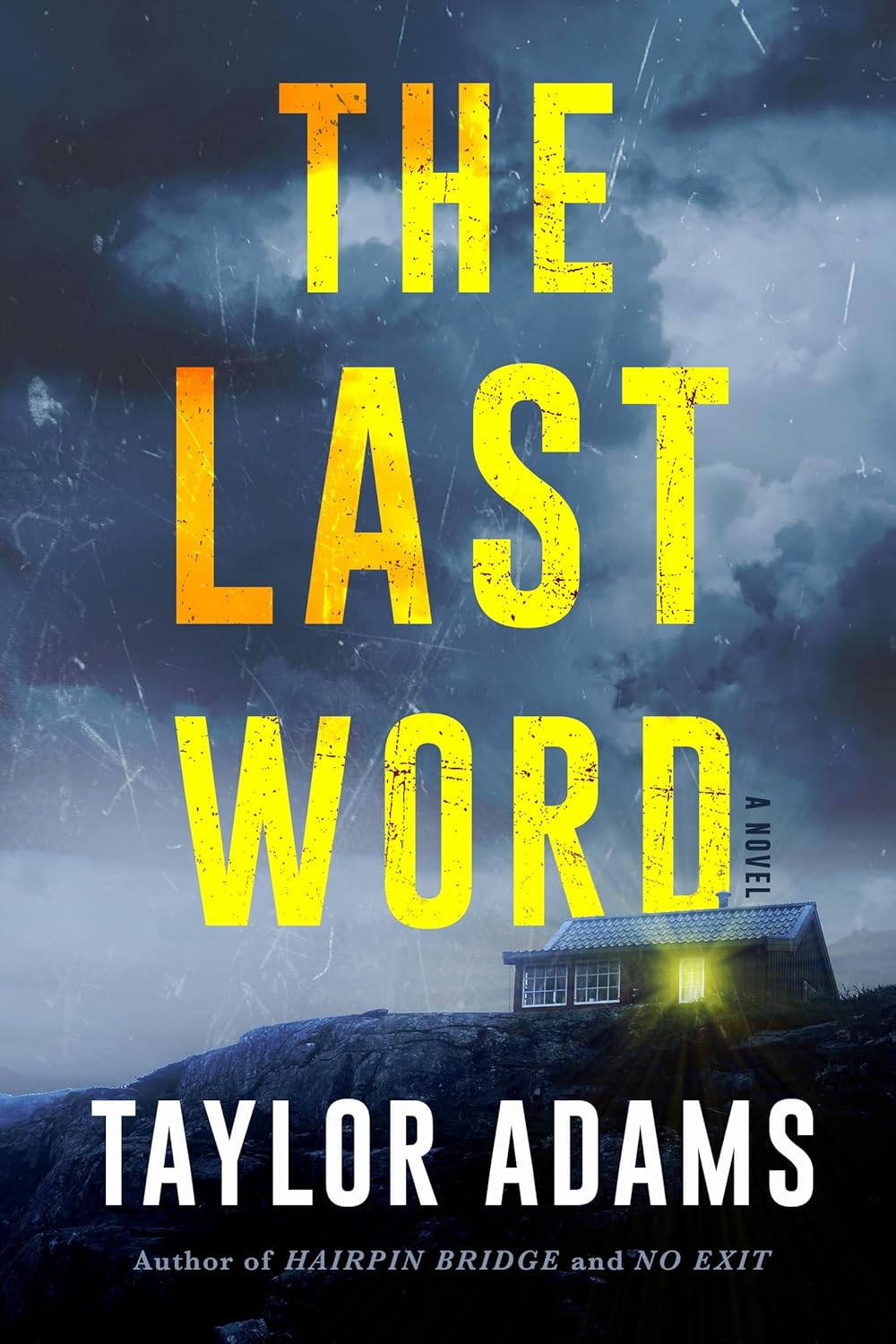
Rating: 4/5 Stars
There’s nothing quite like discovering a book that turns your planned “early bedtime” into an involuntary all-nighter. The Last Word by Taylor Adams is one of those literary criminals—the kind that hijacks your evening plans and leaves you bleary-eyed but satisfied at 1 AM, wondering where the last four and a half hours went.
Emma Carpenter has retreated to the isolated shores of Strand Beach, Washington, house-sitting a remote beachfront property with only her golden retriever Laika for company. Her human contact is limited to cryptic texts from the homeowner Jules and occasional interactions with her enigmatic neighbor Deek. It’s the kind of self-imposed exile that screams “perfect setup for psychological mayhem,” and Adams doesn’t disappoint.
When Emma posts a scathing one-star review of a particularly dreadful horror novel by author H.G. Kane, she expects nothing more than the usual online indifference. What she gets instead is an author with apparently very thin skin and, as it turns out, some deeply disturbing hobbies. Soon, Emma finds herself wondering if her harsh critique has attracted the attention of someone far more dangerous than your average keyboard warrior.
Adams demonstrates masterful pacing throughout The Last Word, structuring the novel in four parts that build tension with surgical precision. Just when you think you’ve settled into a comfortable reading rhythm, the story shifts gears and drags you deeper into its web. The isolated Washington coast setting isn’t just atmospheric window dressing—it’s integral to the story’s success. Emma’s self-imposed isolation at Strand Beach becomes both her refuge and her trap, creating the perfect pressure cooker for psychological terror.
One of the novel’s strongest elements is Adams’s decision to alternate perspectives, giving readers unsettling glimpses into the antagonist’s fractured psyche. These shifts in voice provide fascinating insight into a deeply disturbed mind while maintaining the story’s breakneck pace. It’s psychological thriller writing at its most effective—uncomfortable, revealing, and utterly compelling.
Now, full disclosure: astute readers might piece together certain plot elements earlier than Adams perhaps intended. By page 135, I had a pretty solid guess about the identity of Emma’s tormentor, which was confirmed roughly 100 pages later. But here’s the thing—it didn’t matter. Adams had the foresight to layer multiple twists throughout the narrative, ensuring that even if you crack one mystery early, there are plenty of surprises waiting to knock you off balance.
The book doesn’t shy away from graphic content, featuring disturbing descriptions that earn its place firmly in the psychological thriller genre rather than broader mainstream fiction. Adams explores heavy themes including personal loss, grief, and suicidal ideation alongside the more obvious homicidal elements. These aren’t content warnings to take lightly—this is a book that goes to dark places and isn’t particularly interested in holding your hand along the way.
What makes The Last Word particularly effective is how it plays with the relationship between creators and critics, readers and writers. In our age of Goodreads reviews and social media literary discourse, the premise feels uncomfortably plausible. We’ve all seen authors behaving badly online—but how far might one actually go when faced with harsh criticism? Adams takes this contemporary anxiety and runs it through a psychological thriller blender, creating something that feels both timely and timeless.
The novel’s greatest strength lies in its refusal to rely on a single revelation. Instead of building toward one big twist, Adams constructs a story that continuously evolves, keeping readers guessing until the final pages. It’s the kind of plotting that transforms a good book into an unputdownable one—the literary equivalent of a perfectly engineered mousetrap.
The Last Word marks my first encounter with Taylor Adams’s work, but it certainly won’t be my last. If this is the caliber of psychological suspense he consistently delivers, then No Exit and Hairpin Bridge have just shot to the top of my reading list.
For fans of psychological thrillers who don’t mind their fiction served with a side of genuine menace, The Last Word delivers exactly what it promises: a story that will keep you reading long past your intended bedtime, questioning every shadow and second-guessing every online interaction. Just maybe think twice before posting that next scathing book review—you never know who might be reading.
Content warnings: Graphic violence, themes of personal loss, grief, suicidal ideation, and stalking behavior.
Have you read The Last Word? If so, please share your thoughts in the comments below. Were you pulled into the narrative as strongly as I was? Did Adams surprise you with the multiple twists revealed throughout the final third of the novel?
 The Confusing Middle