In the grand tapestry of Greek mythology, few heroes loom as large as Bellerophon, the divine slayer of monsters whose hubris ultimately led to his downfall. A figure shrouded in conflicting narratives, Bellerophon’s exploits have captivated storytellers for millennia, embodying the eternal struggle between mortal ambition and the wrath of the gods.
Origins and Early Life
Born to the sea god Poseidon and the mortal Eurynome, Bellerophon’s divine lineage set the stage for a life of epic proportions. Raised by his foster father Glaukos, he was known by the epithet “Hipponous” (horse-knower) before an ill-fated knife-throwing incident earned him the name “Bellerophon” (slayer of Belleros).
Exile and the Taming of Pegasus
Like many mythological heroes, Bellerophon’s journey began with exile. Falsely accused of pursuing King Proetus’s wife, he was sent to face a seemingly impossible task – slaying the fearsome Chimera, a fire-breathing beast with the body of a goat, the head of a lion, and the tail of a serpent.
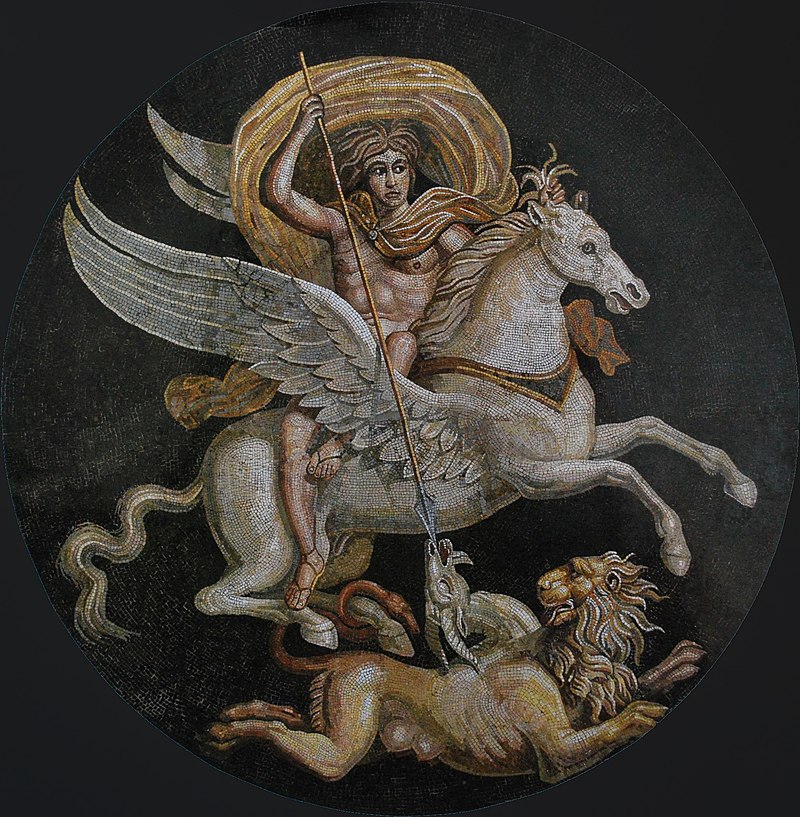
It was here that Bellerophon’s ingenuity shone through. Heeding the advice of the seer Polyeidos, he sought the aid of the winged horse Pegasus, taming the divine steed with the help of Athena’s golden bridle. Armed with Pegasus’s aerial advantage, Bellerophon devised a cunning plan to defeat the Chimera, lodging a lead-tipped spear into the beast’s fiery maw, suffocating it with its own molten breath.
The Slaying of the Chimera and Beyond
Bellerophon’s victory over the Chimera was merely the beginning of his trials. Sent on a series of perilous quests by the disbelieving King Iobates, he vanquished the Amazons, ambushed would-be assassins, and even faced the wrath of Iobates’s palace guards, narrowly avoiding confrontation with the exposed women of the court.
Ultimately, Iobates relented, granting Bellerophon his daughter Philonoe’s hand in marriage and a share of his kingdom. For a time, Bellerophon basked in the glory of his triumphs, fathering several children, including the legendary Sarpedon.
The Flight to Olympus and Downfall
Intoxicated by his success, Bellerophon’s hubris reached its zenith when he attempted to ride Pegasus to Mount Olympus, the realm of the gods. This act of arrogance incurred the wrath of Zeus, who sent a gadfly to sting Pegasus, causing Bellerophon to fall back to Earth.
In some accounts, Bellerophon was blinded upon his fall, forced to wander the Plain of Aleion in Cilicia, “devouring his own soul” in misery until his death. His tragic end served as a cautionary tale against the perils of unchecked ambition and disrespect for the divine order.
Legacy and Impact
Bellerophon’s myth has endured for centuries, inspiring artistic interpretations, literary works, and cultural references. Euripides’ lost tragedy, “Bellerophon,” explored the hero’s downfall, while the emblem of the World War II British Airborne Forces featured him astride Pegasus, a symbol of aerial might.
In the annals of Greek mythology, Bellerophon stands as a testament to the duality of human nature – a divine hero whose exploits inspired awe, yet whose fatal flaw ultimately led to his undoing. His story serves as a timeless reminder of the perils of hubris and the importance of respecting the boundaries between mortals and gods.
 The Confusing Middle